If social networking is creating a new ecology of communication, how is it doing so? It is effectively a way of outsourcing our connections with other people, whereby we no longer need to worry about doing anything so vulgar as actually having to remember birthdays, or ages, or where you met them, or...in certain cases, what their name is. The upside to this should be that by outsourcing our memory in this manner, then we should have more time free to do more things with these people. We don't need to write a letter, or even an email. Perhaps we think we can just send a message, and all is well. The problem is that this theoretical free time is a black hole. Most have had that that experience of trawling Facebook for what we think is just a few minutes, then *snap* you're back in the room and two hours have passed. How is this? Well, as with all technologies, there are benefits and there are drawbacks. This form of communication is low-grade, and labour-intensive. We may get more connected, but this means more active effort is needed maintain these connections.
Showing posts with label social reality. Show all posts
Showing posts with label social reality. Show all posts
Monday, 23 January 2012

Sunday, 1 January 2012
In your own time
Take the point made below about timescales, but reverse it. This is
the more accurate representation of how things stand in terms of
influence. Our own particular, partisan approaches require that things
be presented in the manner I first suggested, but the more exhaustive
reading indicates that the reverse is the case. It seems a minor point,
but it is crucial to the presentation of the argument. Here's why.
In this change of timescales throughout history, the fragmentation of time has taken place just as the individual has risen in importance. Fragmentation here isn't necessarily a bad thing. We can simply observe that from the introduction of clocks in villages and towns, allowing for a more precise breakdown beyond the pace of the ringing of church bells for services, up to the industrial age and the ascent of the pocketwatch (and all the social effects of this) ever smaller divisions of time have become possible. As a result, the grand timescales of dynasties and institutions are now seen as an aggregate of phases, of years and decades and centuries. As such, the long view is no longer regarded as an organic or collective entity unto itself.
Consider this with regard to the phenomenon of European aristocratic dynasties. The Habsburg family (with all its various cadet branches included) claims to trace itself back to the 10th century, and from here they married their way to a continental supremacy that convulsed Europe in war and ruin over the centuries. It would not be fruitful to consider their history in terms of individuals, as our sense of time is different to theirs.
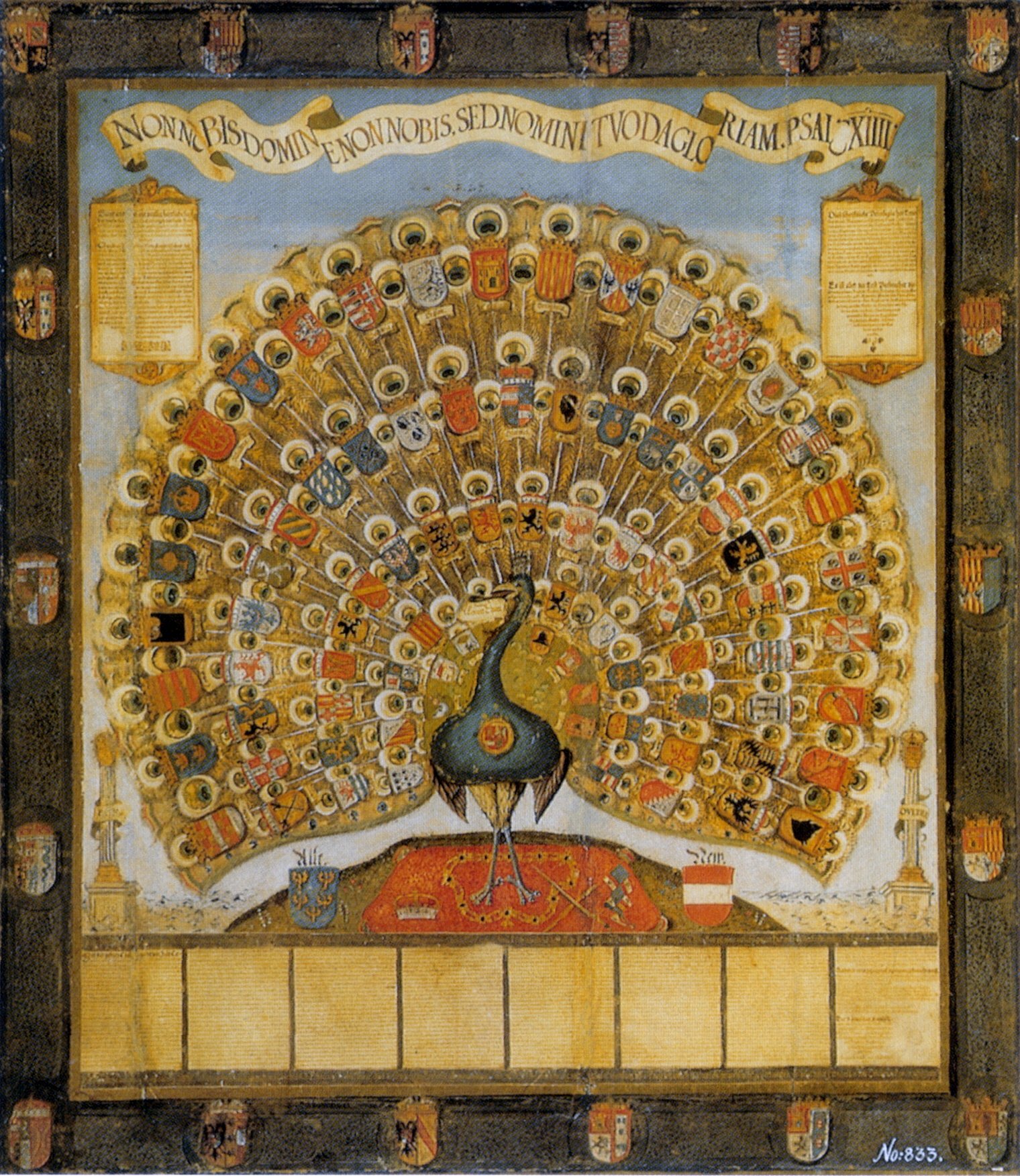 Their
coat of arms is a testament to the various alliances, co-options,
annexations, marriages, and outright thefts that consolidate such a
dynasty as a supra-individual entity. In these terms, we must consider
the context of time and timescales. By leaving out the collective
entity of time, we miss something. In his "Idea for a Universal History from a Cosmopolitan Point of View",
Kant points out in his second thesis that "those natural capacities
which are directed to the use of [...] reason are to be fully developed
only in the race, not in the individual." Ignoring the use of the word
'race' here with it's chauvinistic implications, we see that there is
an awareness of the different implications of different timescales. One
is not superior to another, but has rather a different function.
Their
coat of arms is a testament to the various alliances, co-options,
annexations, marriages, and outright thefts that consolidate such a
dynasty as a supra-individual entity. In these terms, we must consider
the context of time and timescales. By leaving out the collective
entity of time, we miss something. In his "Idea for a Universal History from a Cosmopolitan Point of View",
Kant points out in his second thesis that "those natural capacities
which are directed to the use of [...] reason are to be fully developed
only in the race, not in the individual." Ignoring the use of the word
'race' here with it's chauvinistic implications, we see that there is
an awareness of the different implications of different timescales. One
is not superior to another, but has rather a different function.
In this change of timescales throughout history, the fragmentation of time has taken place just as the individual has risen in importance. Fragmentation here isn't necessarily a bad thing. We can simply observe that from the introduction of clocks in villages and towns, allowing for a more precise breakdown beyond the pace of the ringing of church bells for services, up to the industrial age and the ascent of the pocketwatch (and all the social effects of this) ever smaller divisions of time have become possible. As a result, the grand timescales of dynasties and institutions are now seen as an aggregate of phases, of years and decades and centuries. As such, the long view is no longer regarded as an organic or collective entity unto itself.
Consider this with regard to the phenomenon of European aristocratic dynasties. The Habsburg family (with all its various cadet branches included) claims to trace itself back to the 10th century, and from here they married their way to a continental supremacy that convulsed Europe in war and ruin over the centuries. It would not be fruitful to consider their history in terms of individuals, as our sense of time is different to theirs.
Thursday, 10 November 2011
The Luddites were right
Luddites were not objectively anti-technology, even if that is what their acts of sabotage and destruction might suggest, and even if that is how history has on the whole remembered them. What they were searching for was a way to integrate new technologies into their way of life, rather than allowing each new gadget dictate what form society would take. In this, they were the first to encounter the problem which endures today, namely the disparity between new processes and technologies on the one hand, and on the other, social and political models which took place long before such changes could even have been imagined. It is the divide between the human and the machine. It is an abyss of scale.

What was needed was a new social technology which could have been attendant to the machine and organizational technologies which had been developed. As it was, the machine begat the organization, with the social and human crowded out. Concepts such as "change" and "progress" were introduced which lacked the nuance and sophistication to equip us intellectually with these inventions. This conceptual dearth impoverished our intellectual world to such a degree that only recently have we begun to exit this recession of the mind. Critics of the effects of industrial organization on the lowest levels (such as Engels and Dickens) showed that all was not well, but yet we still needed to have the tools of thought to formulate not just the answer, but also the problem.
One definition of ideology is that which we don't know we know. It is a pervasive paradigm of heuristics, prejudices (in Gadamer's sense), assumptions, and habits. It is that 'unthought' which to some extent leads our thinking. The Victorian moralists who criticized the 'excesses' of their age were still under the dark pall that the smokestacks spread throughout all economic and intellectual life. The should, rather, have been realizing that the problem was the essence of their age. The entire model of industrial scale economics allowed for a skewed accounting, such that those advocates of factories and railroads genuinely believed that theirs was the best way. They had so structured their informational world, that the excesses for which they were critiqued were in fact the foundation for everything they did. Industrialization was predicated upon markets being opened at gunpoint. Industrialism and colonialism are mutually defining.

What works on the international scale works on the local too, however, and 'markets for the sake of markets' is equally reprehensible to the Luddites as it is for the subjugated inhabitant of a colonized land. What was apparent even in 1811, when the Prince Regent offered a reward for information regarding "giving information on any person or persons wickedly breaking the frames" was that it was the new technologies who set the terms against which the actions of people might be measured. Destruction of property was all this matter was, and questions of why there were people attempting to be so destructive were scattered before they could be formulated in the knee-jerk accusation of immorality: destruction of property = evil, end of. Rather than engage in a discussion, it was more convenient to allow a spontaneous order to develop, without thinking it through. It is as though it was decided that the economy to which Adam Smith's invisible hand was attached should be blindfolded too, as long as it suited those whom it benefited.
What was needed was a new social technology which could have been attendant to the machine and organizational technologies which had been developed. As it was, the machine begat the organization, with the social and human crowded out. Concepts such as "change" and "progress" were introduced which lacked the nuance and sophistication to equip us intellectually with these inventions. This conceptual dearth impoverished our intellectual world to such a degree that only recently have we begun to exit this recession of the mind. Critics of the effects of industrial organization on the lowest levels (such as Engels and Dickens) showed that all was not well, but yet we still needed to have the tools of thought to formulate not just the answer, but also the problem.
One definition of ideology is that which we don't know we know. It is a pervasive paradigm of heuristics, prejudices (in Gadamer's sense), assumptions, and habits. It is that 'unthought' which to some extent leads our thinking. The Victorian moralists who criticized the 'excesses' of their age were still under the dark pall that the smokestacks spread throughout all economic and intellectual life. The should, rather, have been realizing that the problem was the essence of their age. The entire model of industrial scale economics allowed for a skewed accounting, such that those advocates of factories and railroads genuinely believed that theirs was the best way. They had so structured their informational world, that the excesses for which they were critiqued were in fact the foundation for everything they did. Industrialization was predicated upon markets being opened at gunpoint. Industrialism and colonialism are mutually defining.
What works on the international scale works on the local too, however, and 'markets for the sake of markets' is equally reprehensible to the Luddites as it is for the subjugated inhabitant of a colonized land. What was apparent even in 1811, when the Prince Regent offered a reward for information regarding "giving information on any person or persons wickedly breaking the frames" was that it was the new technologies who set the terms against which the actions of people might be measured. Destruction of property was all this matter was, and questions of why there were people attempting to be so destructive were scattered before they could be formulated in the knee-jerk accusation of immorality: destruction of property = evil, end of. Rather than engage in a discussion, it was more convenient to allow a spontaneous order to develop, without thinking it through. It is as though it was decided that the economy to which Adam Smith's invisible hand was attached should be blindfolded too, as long as it suited those whom it benefited.
Wednesday, 26 October 2011
Information and stuff: Stephenson and DeLillo
Cryptonomicon and Underworld, two great novels in their respective literary realms, are definitely linked (as Richard Rorty noted in his blurb for the former), and they address each other's weaknesses. They both span much of the last century's history, and they both use the standard approach of the non-linear narrative. Underworld is material, replete with what Hart Crane called "America's plutonic ecstasies" - wastes nuclear, industrial, human... It also, however, misses a crucial trick by more or less accepting the standard model of material progress in the western world, and doing no more than flipping it for our delectation, presenting us with the opportunity to indulge in our bad faith, our consumer guilt. It is an inversion that lacks sophistication. Though the actual work itself is an achievement, the message is banal.
 Cryptonomicon is also a mirror though which we darkly consider our recent past, except instead of how DeLillo gives us the flip-side of our material successes (the world of "Just What Is It That Makes Today's Home So Different, So Appealing?") in muck and mire, Stephenson focuses on information, on the immaterial. He is interested in how its structures structure our lives. More than this, if the 'darkside' parallel is to be valid, then just as the structure of information in the 20th century is such that openness and freedom of digital movement are the ideals held up by theorists and advocates, Cryptonomicon astutely shows that this is more often than not perverted by those who wish to dominate via information and technologies of communication.

With the Baroque Cycle (a trilogy, which serve as a kind of prelude rather than a prequel to Cryptonomicon, which he subsequently penned), Stephenson gives us what amounts to a secret history of the immaterial's ascendancy, which shows that the material world was predicated on this world that was accessible only to those with the particular inclination to learn the language of the universe, maths and physics. Where Underworld is about burying the implications of our approach to living in the world, of using our skills, ideas, tools to alter our surroundings, Cryptonomicon gives us that which we haven't even repressed as we don't know enough about it. Encryption is the key to the whole other side of the bright, shiny story that is peddled out so often by the corporate histories (that not infrequently becomes academic and popular history). Not all the information that is out there is available to us, and we do not make all our own information available to others. Stephenson brings us to the point where we can ask ourselves, should everything be available to all?

With the Baroque Cycle (a trilogy, which serve as a kind of prelude rather than a prequel to Cryptonomicon, which he subsequently penned), Stephenson gives us what amounts to a secret history of the immaterial's ascendancy, which shows that the material world was predicated on this world that was accessible only to those with the particular inclination to learn the language of the universe, maths and physics. Where Underworld is about burying the implications of our approach to living in the world, of using our skills, ideas, tools to alter our surroundings, Cryptonomicon gives us that which we haven't even repressed as we don't know enough about it. Encryption is the key to the whole other side of the bright, shiny story that is peddled out so often by the corporate histories (that not infrequently becomes academic and popular history). Not all the information that is out there is available to us, and we do not make all our own information available to others. Stephenson brings us to the point where we can ask ourselves, should everything be available to all?
Wednesday, 21 September 2011
Der Untergang des Magnum Opus
Quite aside from the basic and dull point that is made ad vomitum regarding "master-narratives", one alternative way to regard the decline of "great works" is the fact that writers are coming to be regarded, and to regard themselves, as accidents. It is a fact of our social structures, in a two-fold manner.
Firstly, in the narrative perspective whereby our overview of history needs actors for reasons of identification, the great writer or their text can serve this function, as a cognitive anchor. It is a way to make history less autistic, less concerned with facts. That is the "history of literature" view, but it holds true in any field, whereby an -ism is deployed like a sheep dog to round up those pesky individuals with fancy notions of freedom and independence.

Firstly, in the narrative perspective whereby our overview of history needs actors for reasons of identification, the great writer or their text can serve this function, as a cognitive anchor. It is a way to make history less autistic, less concerned with facts. That is the "history of literature" view, but it holds true in any field, whereby an -ism is deployed like a sheep dog to round up those pesky individuals with fancy notions of freedom and independence.

Speculative Realism
Evidently, a text can serve just this function, but with each repeated deployment it has become increasingly attenuated. It got to the point where Adorno's Aesthetic Theory can, in its blurb, be referred to as his magnum opus. The fact that he did not complete it during his lifetime is related to the sapping of the ideal that such a book has, as much a result of an atmosphere where the fragment is fetishized (need one give examples?), as well as one in which we can witness its reactionary rejection (but this reaction is usually political in tone, thus Badiou's elevation of the Event, which is a tellingly Maoist movement, but good god I digress...) . The point, again, is that not all great texts surpass everything by their contemporaries, and so some are chosen by default, simply as others will never be considered once this process has taken place.
The second manner is that whereby fame accrues more fame. Like any standing reserve in a structure (money, information, etc.), there is a network effect in evidence. Fame can cycle endlessly, as in Bataille's "general economy" (which is in contrast to the "restricted economy" that we are led to understand is economics proper), and once the surplus standing reserve being left to pass down along the same well-worn channels of a text having a place in the canon, or of a thinker being a part of an -ism, until it this channel is blocked. The point is that now there are so many various opportunities, that it becomes a question as to whether there is sufficient force behind the flow to create more than a trickle of renown. We see this in the notion that there are "too many journals", but as noted in this link, often these journals are no more than tags attached to articles.
This is not a jeremiad against change, and I find the point made by Jan Velterop in that link more helpful, as it allows us to view the old problem in a new light. People have complained about there being too many books since there were two books. What changes is the structure that governs and facilitates our access to and interactions with these works. Accordingly, we get fields (can I please call this the "sheepdog effect"?) of influence, counter-influence, rejection, interest, and all these interact with myriad others. Returning to Adorno for a moment, we can see an analogy of this where the punning title of his work gives us a Minima Moralia rather than the Magna Moralia of Aristotle, a collection of observations which can be fashioned into a constellation by our own effort to read him, as well as what we bring from our reading others. The age of the magnum opus had its dark counter-image in the dilettante, but our age needs to develop its alternative to this.
Monday, 15 August 2011
WAR (hyuh, yeah)... what is it good for? Tech stocks
Any time I get into a conversation with somebody who is either interested in philosophy, or involved in technology, I somehow manage to steer conversation around to a basic problem I have, which is that technologists (Kevin Kelly, Ray Kurzweil, Barabasi, et al.) often seem to have an all-too-unambiguous relationship with the applications of their chosen field to warfare. This is a primarily ethical problem, but we can displace it into the political realm if we wish to remain dispassionate. I would like to push our conceptual apparatus even further (mainly to avoid my own rhetorical excesses), and to attempt an alternative view, namely to consider this problem in even more abstract terms.
Step back for a minute, and consider G.K. Chesterton's words on the detective novel:
keep in some sense before the mind the fact that civilization itself is the most sensational of departures and the most romantic of rebellions … It is based on the fact that morality is the most dark and daring of conspiracies. (from “A Defence of Detective Stories”)
When I reflect on this, it leads me to note the quite peculiar status of nature's relationship with all things man-made. There is, however, no simple good versus evil opposition. There is no reason why we should consider nature to be more beneficial to us than something constructed or artificial. The ebola virus comes from nature, hospitals are constructs – a crude pair of examples to be sure, but consider this as an antidote to any opposing crudity. Man-made and natural simply are, and both have different functions, derivations, etc. To valorise nature over a product of civilization is no more than, to paraphrase LCD Soundsystem, borrowed nostalgia for an unremembered time (which is the essence of Heidegger's “The Question Concerning Technology”). At best, it is the philosophy of “I remember when all this was fields”. Now, returning to G.K. Chesterton, there is nevertheless a tension between these two, given that the natural is what we humans ever attempt to pacify and combat (Francis Bacon), to transcend (Ray Kurzweil). The status quo, on this cosmological perspective, is entropy. This is our opponent.
So, to leap back to where we were with this in mind, war/defence (choose your euphemism) is an example of this will-to-break-down that is the reality of life. This is a fairly awkward definition, but bear with me. It is inevitable, this destruction; there is but a difference of time-scales between the cosmological entropy of the second law of thermodynamics, and our own short-term analogy in social and political conflict.
This is not an apologia for violence, but it is the recognition of a (deeply unpleasant) fact of our present social reality (and, contrary to arcadian myths of noble savages, it is our past too). What we continually do is find ways to reduce the prominence and frequency of this fact of strife in our lives. It is not geological fatalism to say that erosion happens (allow me this minor contradiction in terms), and so it should not be considered fatalism that to say that similarly a type of socio-political erosion will happen. As I am being crushed under the weight of this belaboured analogy I will just say we should erect defences to protect ourselves and our institutions from this decay. It is our duty to recognise the existence of conflict, strife, warfare – and to do something about it. Human activity, technology, ideas are a part of a concerted effort (better a musical than a martial metaphor) to diminish, in an on-going manner, destruction at our own hands, as well as obliteration by the forces of nature.
Now that I have lost just about everybody with this line of argument, I can return to philosophy and technology. War and destruction are not addressed in the philosophy and history of technology as the catalytic forces they are (only Schumpeter comes close with "creative destruction"). I find this fundamentally troubling that human ingenuity and the ideology of technology (Daft Punk's harder, better, faster, stronger) is so readily applied to killing and exploitation. This is the impulse behind this tortured argument. As such, I have attempted to see matters from a different perspective, considering ourselves on the Darwinian time-scale. Survival in the present moment in order to pass on genes to the future is what is of prime importance to the organism (there are limit situations where this does not hold, but they are exceptional). Thus, any new technology could follow a distribution whereby it will be applied to these immediate needs of survival, even if these needs are only apparent (this requires a whole subsidiary caveat whereby we note the corporate-media nexus, and how “need” is created as part of a market strategy). In my dangerously telescoped argument, rocketry begins as warfare, and becomes a tool of government and science, and expands into the civilian and commercial realm. What was once closed-source becomes marginally less so. Vast sums of money are spent on defence in the United States, partly because it is effectively a standing tradition of budgets in that country to spend the rest of the world (i.e., enemies) into submission, so inevitably a lot of that will filter into research and development.

The top right-hand corner is the amount spent by the U.S. on the Iraq war. Click to see full-size version.
A part of that then will go into military applications, and then a smaller amount of that will be considered viable for actual manufacture and deployment. Even if, as the argument goes, the space race was the Cold War-by-proxy, note the difference whereby the “by proxy” in effect negates “war”. Yet another example is of course the Internet as we know it today, which was developed by the military as a means of decentralizing communication which would ensure that in case of an attack, the system would continue to function.
Returning to the ethical argument, which I bracketed away at the beginning of all this, there is surely room for us to be involved in war/defence, and yet to be doing our best to reduce the possibility of it ever happening. We are aware of the genesis of the Gatling gun, and how its inventor hoped that it would end warfare by its very efficiency and the enemy's fear of deployment; this utopian view did not account for how cheaply politicians and generals regarded their soldiers' lives. That said, the war-gamers at the RAND corporation, DARPA, the NSA, each in their own way undertook the effort to make nuclear war an ever less attractive option via their development of a doomsday logic, namely the doctrine of Mutually Assured Destruction. (Interestingly, a friend of mine informed me that this was communicated to the Soviet side too, in both abstract and concrete terms, for M.A.D. could not have functioned unless both sides were aware of its rules, according to the nature of Game Theory). We can but hope that by developing M.A.D., this leveled out the curve of inevitability which saw an ever increasing number of fatalities with each global conflagration, with WWI surpassed by WWII, which all feared would be surpassed by a WWIII. Large scale war became an ever less attractive possibility, such that now wars are economic, diplomatic, and both of the above, as well as the actual wars which the superpowers waged either by proxy or by feigned ignorance in the second half of the c20th (see Niall Ferguson's The War of the World on this).

We should allow ourselves to be reigned in, then, by an ethics of technology. Let there be a stricture set down, following Mario Bunge's observation that technology's morals right now are dubious at best, whereby we will not develop any technology which is dedicated to our own oblivion. Let a philosophy of possible worlds (and not just Candide's “best of all possible worlds” which seems to govern the most rosy-VR-goggled futurists such as Kurzweil) consider the worst possible outcomes of each new technology.
Friday, 12 August 2011
The Fallacy of Invention
In the sixth chapter of his book, The Nature of Technology , "The Origin of Technologies", W. Brian Arthur considers how technology is actually brought into being. It follows on from his observation that a technology is the exploitation of a natural phenomenon or principle to a specific end. As such, he notes that:
'Typically several groups of inventors have envisaged the principle in action at more or less the same time and have made attempts at a working version of it. Such multiple efforts and filling in of key pieces make it difficult to speak of "invention" in the sense of being first.'
He goes on to give an example of this, but consider it in the abstract for a moment. If we cannot say that invention in the "hard" sense of the lone genius tinkering away and creating something civilization-altering, then what type of reconsideration does this call for us to make?

Well, if we move from a "hard" notion of invention (which, as an aside, is a part of the myth of creative genius that was adopted to a large extent by those who wrote about rather than practiced scientific and technological investigation. I'm looking at you Mary Shelley...) to a "soft" one, we can then have either:
(a) the idea of co-operation, with science as a collective enterprise, which is a standard refrain of the sociology of science, and finds support in the advent and successes (though subject to diminishing returns?) of Big Science.
(b) the idea of there still being an individual innovator, but now their particular works contributes to an external, even transcendent "atmosphere" of innovation. This is the view that notes both Leibniz and Newton worked on the calculus in the c17th, and so there was something in the water that caused them to make these advances.
Well, I have problems with both these views (which is funny, since I was the one who proposed them). The first is a crushingly dull, pragmatic view of science. It is descriptive in a way which doesn't inspire further investigation. It seems content to accept this view as a fact of reality, without setting it up as a platform for further investigation. "This is this is this, and that's that." The second, though extreme to some, as it will appear to set up technology as a disembodied force, an autocatalytic entity that exists unto itself. Radical though this interpretation may seem, I read enough science fiction for this view to not go far enough (italics = I really mean it).

The question I want to pose is the following: if we allow that the standard idea of invention is sufficient, do we go on finessing it into newly watered-down versions (development, for example), purely to conform to some ideal whereby words precisely mirror something found in a natural state in reality? Clearly not, as this suffers the fate of infinite regress - "turtles all the way down". Still, words are imprecise, and we still use them, so we need to borrow a bit from column a, and a bit from column b. From the first in terms of invention we need to recognise the messy aspect of social reality, and from the second we need to recognise that there is something weirdly sci-fi about technology when considered in the abstract. It does seem to have a logic of its own, and so perhaps our social reality ought to reflect this, rather than trying to force invention, scientific creativity, and technology (the sources of this information age) into an out of date model of high-industrial capitalism.
Invention needs to be brought into line with what we know about ideas and how they permeate and power our information civilization. We are a network society, in Manuel Castell's phrase, and we are moving away from the zero sum game logic that resulted in the destructive rapacity and exploitation of the c19th entrepreneurial model. Even the high priests of this (such as Rockefeller, Carnegie), knew their way of doing things could not be maintained. They sought to atone after the fact via their good works (giving us insidious nonsense as found in that hateful coinage "philanthrocapitalism"), blighted in their thinking by a tit-for-tat, linear logic. From the very beginning, however, we must see the structural conditions of any situation.
 Caption reads: "Forty-Millionaire Carnegie in his Great Double Role. As the tight-fisted employer he reduces wages that he may play philanthropist and give away libraries, etc."
Back to invention, and we see that invention is always a part of a network of ideas, building upon previous advances, and drawing upon the work of others (in terms of both actual physical, back-breaking labour, and the other mentally creative sort). The short-cuts taken by a business to increase productivity are also part of a network, but one that impacts others, elsewhere, at some other time. Why should our social reality (in legal, political terms) not directly recognise this? The creative commons and open source are a direct and logical corollary of social reality's inherently networked nature. Invention (here a synecdoche, not a straw man...I hope) is evidence of this, and we need greater fidelity in our conceptual apparatus when thinking about technology.
, "The Origin of Technologies", W. Brian Arthur considers how technology is actually brought into being. It follows on from his observation that a technology is the exploitation of a natural phenomenon or principle to a specific end. As such, he notes that:'Typically several groups of inventors have envisaged the principle in action at more or less the same time and have made attempts at a working version of it. Such multiple efforts and filling in of key pieces make it difficult to speak of "invention" in the sense of being first.'
He goes on to give an example of this, but consider it in the abstract for a moment. If we cannot say that invention in the "hard" sense of the lone genius tinkering away and creating something civilization-altering, then what type of reconsideration does this call for us to make?
Well, if we move from a "hard" notion of invention (which, as an aside, is a part of the myth of creative genius that was adopted to a large extent by those who wrote about rather than practiced scientific and technological investigation. I'm looking at you Mary Shelley...) to a "soft" one, we can then have either:
(a) the idea of co-operation, with science as a collective enterprise, which is a standard refrain of the sociology of science, and finds support in the advent and successes (though subject to diminishing returns?) of Big Science.
(b) the idea of there still being an individual innovator, but now their particular works contributes to an external, even transcendent "atmosphere" of innovation. This is the view that notes both Leibniz and Newton worked on the calculus in the c17th, and so there was something in the water that caused them to make these advances.
Well, I have problems with both these views (which is funny, since I was the one who proposed them). The first is a crushingly dull, pragmatic view of science. It is descriptive in a way which doesn't inspire further investigation. It seems content to accept this view as a fact of reality, without setting it up as a platform for further investigation. "This is this is this, and that's that." The second, though extreme to some, as it will appear to set up technology as a disembodied force, an autocatalytic entity that exists unto itself. Radical though this interpretation may seem, I read enough science fiction for this view to not go far enough (italics = I really mean it).
The question I want to pose is the following: if we allow that the standard idea of invention is sufficient, do we go on finessing it into newly watered-down versions (development, for example), purely to conform to some ideal whereby words precisely mirror something found in a natural state in reality? Clearly not, as this suffers the fate of infinite regress - "turtles all the way down". Still, words are imprecise, and we still use them, so we need to borrow a bit from column a, and a bit from column b. From the first in terms of invention we need to recognise the messy aspect of social reality, and from the second we need to recognise that there is something weirdly sci-fi about technology when considered in the abstract. It does seem to have a logic of its own, and so perhaps our social reality ought to reflect this, rather than trying to force invention, scientific creativity, and technology (the sources of this information age) into an out of date model of high-industrial capitalism.
Invention needs to be brought into line with what we know about ideas and how they permeate and power our information civilization. We are a network society, in Manuel Castell's phrase, and we are moving away from the zero sum game logic that resulted in the destructive rapacity and exploitation of the c19th entrepreneurial model. Even the high priests of this (such as Rockefeller, Carnegie), knew their way of doing things could not be maintained. They sought to atone after the fact via their good works (giving us insidious nonsense as found in that hateful coinage "philanthrocapitalism"), blighted in their thinking by a tit-for-tat, linear logic. From the very beginning, however, we must see the structural conditions of any situation.
Back to invention, and we see that invention is always a part of a network of ideas, building upon previous advances, and drawing upon the work of others (in terms of both actual physical, back-breaking labour, and the other mentally creative sort). The short-cuts taken by a business to increase productivity are also part of a network, but one that impacts others, elsewhere, at some other time. Why should our social reality (in legal, political terms) not directly recognise this? The creative commons and open source are a direct and logical corollary of social reality's inherently networked nature. Invention (here a synecdoche, not a straw man...I hope) is evidence of this, and we need greater fidelity in our conceptual apparatus when thinking about technology.
Tuesday, 9 August 2011
If it's not on Facebook, it didn't happen.
That's the popular wisdom of today at least. But hey! Let's not assume we are surrounded by idiots and instead try to find the dust off the scrapings off the husk off a seed of truth there somewhere.
In this there is first the point that our memories aren't the best, and so we outsource to various technologies. Previously these would have included journals, diaries, letters, then Polaroids, Super-8, up to the blogs and various other media of networked communication. That's the basic 'storage' problem.
There is also something else, however, which is a bit more numinous, and it is that nebulous idea that fetishists of technology (be they committed, or opportunistic such as those in technology marketing/p.r. [I refuse to give public relations a seal of approval via capitalization]), in terms of a supposed innately human need to connect. Remove the hyperbole, and there is simply the structural resilience of connecting things to other things that brings the storage of my first point to a quite different level.
We are inhabitants of a social rather than a merely physical reality. So if you have a thought or an idea, this is wonderful, but it has no social reality, and it has no reality that can be accessed by anyone other by yourself via your own memories - and that's assuming you remember. So, by embedding this idea or thought in a formal structure (and this is a purposefully inclusive notion, so that it can include writing, painting, photography, programming) it becomes a part of social reality.
In network terms, a node is a node is a node if left to itself. What makes it become more than this is if it is connected. So, by communicating in this manner, an escape velocity is attained such that we can escape the circular logic of solipsism. The argument for open-source and the commons holds for all thought and creativity. I may have had the occasional idea in the past that I scribbled down in a notebook...but if people can't read it, why bother write it?
In this there is first the point that our memories aren't the best, and so we outsource to various technologies. Previously these would have included journals, diaries, letters, then Polaroids, Super-8, up to the blogs and various other media of networked communication. That's the basic 'storage' problem.
There is also something else, however, which is a bit more numinous, and it is that nebulous idea that fetishists of technology (be they committed, or opportunistic such as those in technology marketing/p.r. [I refuse to give public relations a seal of approval via capitalization]), in terms of a supposed innately human need to connect. Remove the hyperbole, and there is simply the structural resilience of connecting things to other things that brings the storage of my first point to a quite different level.
We are inhabitants of a social rather than a merely physical reality. So if you have a thought or an idea, this is wonderful, but it has no social reality, and it has no reality that can be accessed by anyone other by yourself via your own memories - and that's assuming you remember. So, by embedding this idea or thought in a formal structure (and this is a purposefully inclusive notion, so that it can include writing, painting, photography, programming) it becomes a part of social reality.
In network terms, a node is a node is a node if left to itself. What makes it become more than this is if it is connected. So, by communicating in this manner, an escape velocity is attained such that we can escape the circular logic of solipsism. The argument for open-source and the commons holds for all thought and creativity. I may have had the occasional idea in the past that I scribbled down in a notebook...but if people can't read it, why bother write it?
Subscribe to:
Posts (Atom)