Thursday, 12 January 2012
Inevitability of irony
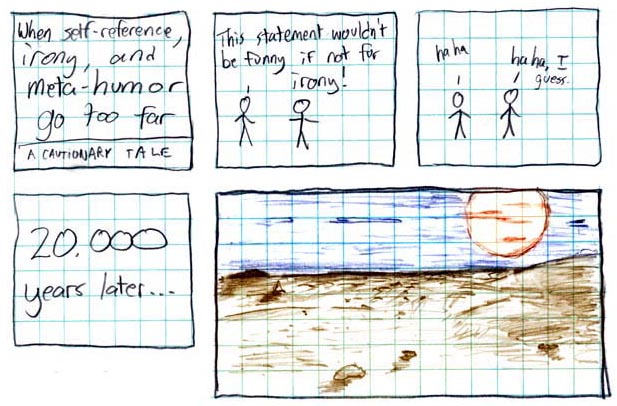
There is a structural inevitability to all discourse, such that as it progresses, it inheres learning within itself, creating more, growing, until ultimately it begins to query its conditions of possibility. This is irony, and it is not necessarily purely out of some sort of cognitive paralysis, as irony is all too often dismissed. It is not some disease of modern thought. It is a part and parcel of all discourse. It is in fact a permanent fact of all expert systems (Fernand Hallyn, The Poetic Structure of the World: Copernicus and Kepler, pp. 20-2), literature, and indeed to the vast complex of a culture's discourse in toto. Irony is an effort to reconsider the structural presuppositions that a discourse relies upon, most likely because of a perceived need for improvement and an awareness that the discourse one is using is coming up to the limits of its usefulness. It is the intuition that a discourse could operate better, could be more precise and efficient.
 Often irony proceeds as a knowing and saying too much, as a show that one has mastered the vast amount of materials available in a given field (one cannot be ironic without this overflowing of knowledge), to the extent that jokes, puns and other diversions not only become possible but may seem necessary to maintain interest in a given topic. With this, interest ceases to be "constructive", and rather becomes a performance, and aesthetic. One is 'knowing' rather than knowledgeable. If we consider the pyramid of David McCandless below, it seems that in irony we slide back down from knowledge into information. We no longer have coordinating ideas to pull information together into a coherent structure. Irony is a kind of decoherence rather than incoherence. If we use the analogy of the stock market, then irony is a symptom of massive overvaluation, and any backlash against it such as "The New Sincerity" (see here for the neutered and here for the enthusiastic versions) is a crash, and an inevitable one (or necessary depending on your view). What emerges after this is that which has run a gauntlet of functionality, as it has demonstrated its worth via its robustness in the onslaught of critique.

Wednesday, 11 January 2012
The Whig interpretation of information: Is open source inevitable? I
The following is an attempt to trace some of the outlines of an element of the ideology of technology, it is not a detailed sociological analysis. The standard political model favoured by many interested in information technologies point to the supposed inevitability of openness. It is a techno-libertarianism that hovers over all discussion, our standard right-on refrain. Certainly it can be regarded as a goal, but more along the lines of a regulating ideal, rather than a Five Year Plan. This is a polite way of saying we don't back any of this up with action. The argument for openness is in its essence a historical one, which notes that once there had been an information technology that somebody attempted to control, there followed a breakdown of this control, with a free and open exchange following. I draw a parallel with Herbert Butterfield's thesis of the Whig interpretation of history, which recasts past history with a view to the present. Accordingly, an apparent chain of progress can be easily discerned from the chaos of the past, if you know what you are looking for. Such is the confirmation bias. This, however, misses the structures through which information is made available, those other technologies that have an influence - and there are many of them. In one set of terms this is how information and indeed an entire information technology is encoded. We need to confront the problem of context.
 Reading the above outline (and I also think of Stephenson's Cryptonomicon mentioned previously) we must see that not all information is (or should be?) available as the ideal might hold. Indeed, openness is not a default. Were it so, should codes from history spontaneously decay into sense via some entropy of coherence? Openness is not a default because encoding is a technology. So too must we consider its recoding into openness (not decoding, which is then a contradiction in these terms). The myth of openness is based in reality, as all myths are, but it forgets TANSTAAFL, there ain't no such thing as a free lunch. This is a governing principle of information theory as much as it is thermodynamics.
According to the model I am proposing to dismiss, communication works as follows. whereby we speak openly to communicate a message, and then write this down so it is intelligible to both sides, and then it is encrypted. What this picture (or straw man, if I am totally off the wall) does not allow is that which a thoroughgoing techno-functionalist position can account for, namely the following. Speech is a form of encoding, long accepted and widely available, but a technology nonetheless. So too is writing. So too is transforming that writing into a second level of sense, namely an encoded (recoded according to my view) piece of writing, though of course it need not be writing. Codes do not degrade, they are broken. We invent a technology to extract sense from the encoded text, and thus we make it appear as though we have reversed the arrow of time, stepping into a past where the message we seek had not yet been put into that secret code which cloaks it. It almost appears as though we got that free lunch. We did not. If encryption is but another form of encoding. Encryption is as much a technology as is any other encoding. Openness too is a technology.
Is this an invalid conflation of discussing open source in the same breath as encryption? I do not believe so, and I do not compare them say they are equivalent, who cares. I do not propose indifferentism. I am saying that because there is no arrow of inevitable openness, one must actively fight for openness (with open source but the latest example of this). Pace the egotism of Julian Assange, we cannot have a knee-jerk ideology where we have a right to know everything at all times. Sissela Bok's Secrets from 1983 (currently out of print, but a contemporary New York Times review gives a fair outline) examines the issues surrounding secrecy, and notes that openness in the realm of science (which is broadly speaking where we might place the open source movement) has quite a different function to the role of secrecy in investigative journalism, whistleblowing, undercover police operations, and secrets of state (these and other issues each get their own chapter).

See also, "Is open source inevitable? II"

According to the model I am proposing to dismiss, communication works as follows. whereby we speak openly to communicate a message, and then write this down so it is intelligible to both sides, and then it is encrypted. What this picture (or straw man, if I am totally off the wall) does not allow is that which a thoroughgoing techno-functionalist position can account for, namely the following. Speech is a form of encoding, long accepted and widely available, but a technology nonetheless. So too is writing. So too is transforming that writing into a second level of sense, namely an encoded (recoded according to my view) piece of writing, though of course it need not be writing. Codes do not degrade, they are broken. We invent a technology to extract sense from the encoded text, and thus we make it appear as though we have reversed the arrow of time, stepping into a past where the message we seek had not yet been put into that secret code which cloaks it. It almost appears as though we got that free lunch. We did not. If encryption is but another form of encoding. Encryption is as much a technology as is any other encoding. Openness too is a technology.
Is this an invalid conflation of discussing open source in the same breath as encryption? I do not believe so, and I do not compare them say they are equivalent, who cares. I do not propose indifferentism. I am saying that because there is no arrow of inevitable openness, one must actively fight for openness (with open source but the latest example of this). Pace the egotism of Julian Assange, we cannot have a knee-jerk ideology where we have a right to know everything at all times. Sissela Bok's Secrets from 1983 (currently out of print, but a contemporary New York Times review gives a fair outline) examines the issues surrounding secrecy, and notes that openness in the realm of science (which is broadly speaking where we might place the open source movement) has quite a different function to the role of secrecy in investigative journalism, whistleblowing, undercover police operations, and secrets of state (these and other issues each get their own chapter).
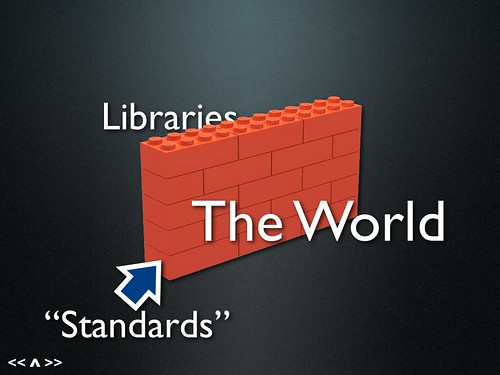
Lego: a threat to open source.
Open source as an idea as well as a movement needs to realise that because it is inextricably linked with trade and corporate secrecy (another chapter of Bok's), then for this to be more than a flash-in-the-pan, it must become part of an ecology of openness, interacting with problems such as copyright, and the knowledge economy. Indeed, regarding the former, there has been for some time an awareness of this, found in the idea of copyleft, which enacts a philosophy of pragmatic idealism, as outlined by Richard Stallman. This is not the time for micropolitics, but for a statement of intent, a declaration whereby we might make our unthought and unspoken assumptions real. One more effort, technologists, if you would become opens source!See also, "Is open source inevitable? II"
Sunday, 8 January 2012
Ideas and criticism
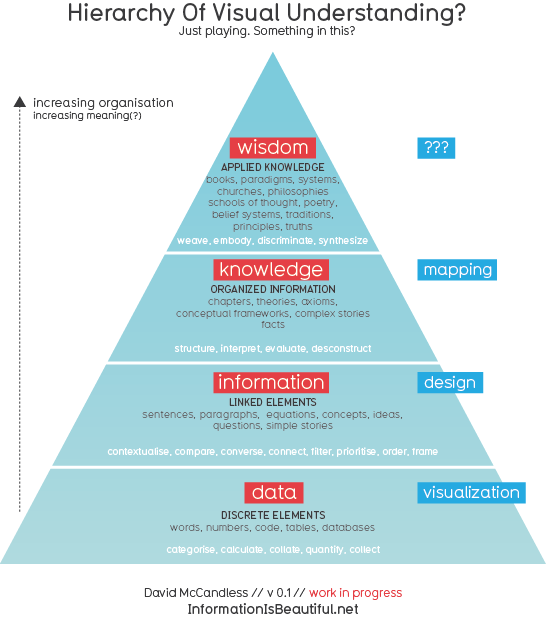
If an idea is presented, and elements of it are questioned in a manner that parries but does not thrust, if it is purely surface, does this in fact have any merit as criticism? A criticism ideally has a purpose, which is basically to be a form of troubleshooting. It must be specific, it must engage with the topic. To not do this is equivalent to saying "well I haven't used the software you developed, but it's probably rubbish" (we might call this The Troll's Refrain). Stand back and ask how does this help us to actually improve the idea. Even thinking 'us' is useful, because if there's a conversation, then there is a joint effort. David McCandless (author of the excellent Information is Beautiful) has a useful breakdown of how we think about the world, in the following pyramid:
 In this, there is a progressive hierarchy of whittling out what is irrelevant, the old effort of separating the wheat from the chaff. This means that the bottom is a field somewhere, and so the top is presumably a Weetabix. Ideas are about turning information into knowledge, they move us from one level to the next. The non-criticism I am thinking of above seeks to move us back down, from knowledge back to information, or data. Instead of information, it focuses on noise.
 There is a temptation in all debate to ask for greater and greater precision, but at the same time you have to step back and ask what level of perfection you want. If ideas are to be abstract, then they of course cannot account for everything. What we are searching for is a degree of functional 'robustness'. This is a term which Kevin Kelly makes continuous reference to in his writing (I am mainly thinking about 1995's Out of Control, which has dated far less than I would have expected), denoting that capacity for enduring networks of communication to cope with unpredictability. It is a nice antidote to management horseshit about "best practice" because it factors into its very structure that we start from least worst, and go on from there. We trade off a small degree of efficiency for a considerably greater degree of structural toughness. There will ever be noise, but not every blip is a threat to the entire system. Ideas are supposed to be solutions, and they are not to be rejected on aesthetic grounds. If it works it works, and from there we can begin the work of making our solution elegant.

Saturday, 7 January 2012
It's Kant...but IN SPACE!: or, MC Hammer versus Missy Elliot.
"We here propose to do just what Copernicus did in attempting to explain the celestial movements. When he found that he could make no progress by assuming that all the heavenly bodies revolved round the spectator, he reversed the process, and tried the experiment of assuming that the spectator revolved, while the stars remained at rest. We may make the same experiment with regard to the intuition of objects."
- Immanuel Kant, Critique of Pure Reason, Preface to the Second Edition [B xv], Meiklejohn trans.
In any discussion of either Kant of the philosophy of the Enlightenment, this idea is one of the first we encounter. It is either noted simply as his "Copernican revolution", or it is glossed in terms of scientistic hubris and a dangerous precedent for thought. I had regarded it more as the latter the first time I encountered this text, but upon reading it now, it has a decidedly different tone, one which causes me to silence the part of me that recognises and acknowledges metaphor when I encounter it. Instead, I think I am only just now getting what Kant is actually saying here. This language is considerably less figurative than I had at first thought (I may simply be slow, I make no claims to novelty here). It is not simply a rhetorical flourish; the extended metaphor of the successive governments of the queen of the sciences in the first preface illustrates that, at any rate, if Kant goes to the effort of devising a metaphor, he'll get his thaler's worth. Admittedly, he is not regarded as a master stylist, and if ever the joke "I am sorry for this being so long, but I hadn't the time to make it any shorter" applied to a philosopher, well... Kant was it.


- Immanuel Kant, Critique of Pure Reason, Preface to the Second Edition [B xv], Meiklejohn trans.
In any discussion of either Kant of the philosophy of the Enlightenment, this idea is one of the first we encounter. It is either noted simply as his "Copernican revolution", or it is glossed in terms of scientistic hubris and a dangerous precedent for thought. I had regarded it more as the latter the first time I encountered this text, but upon reading it now, it has a decidedly different tone, one which causes me to silence the part of me that recognises and acknowledges metaphor when I encounter it. Instead, I think I am only just now getting what Kant is actually saying here. This language is considerably less figurative than I had at first thought (I may simply be slow, I make no claims to novelty here). It is not simply a rhetorical flourish; the extended metaphor of the successive governments of the queen of the sciences in the first preface illustrates that, at any rate, if Kant goes to the effort of devising a metaphor, he'll get his thaler's worth. Admittedly, he is not regarded as a master stylist, and if ever the joke "I am sorry for this being so long, but I hadn't the time to make it any shorter" applied to a philosopher, well... Kant was it.

Fail.
He is not attempting to point out that he is on the same level of awesomeness as Copernicus, nor is he attempting to arrogate some scientific kudos for critical philosophy. He is rather no more than noting that he is effecting a similar change of perspective. I assume that if one knows the name Copernicus, one understands that he was responsible for kicking off the modern shift in science away from an Aristotelian/Ptolemaic or geocentric conception of the universe (where the Earth stands at the centre, and everything else wheels off elsewhere with its epicycles and epicycles of epicycles &c.) to the modern, heliocentric model. With Copernicus and those who followed, we were no longer it. We were no longer the centre of the universe, except in our own feverish egotistical imaginings. 
Kantian.
Another of Kant's famous sentences, and one that he arranged that should be engraved on his gravestone is the following: "Two things fill the mind with ever-increasing wonder and awe, the more often and the more intensely the mind of thought is drawn to them: the starry heavens above me and the moral law within me." The former is what concerns me more, even though the moral element is what gets more press (as much as transcendental critique gets attention these days). Nature and science were hugely important to Kant, and he was no mere dilettante. Accordingly, he had a proper understanding of what Copernicus had done. Where before astronomy had put humanity at the centre, the new heliocentric model did away with this, and in the process exposed our limitations. We did not know everything. Aristotle was not correct in all things (this was a serious epistemological threat to the church, thus the Inquisition requesting the pleasure of Galileo's company).
Basically Kant does the same thing for philosophy as Copernicus: he put our conceptual model down on the page, flipped it, and reversed it. He pointed out that our assumptions about how we engage with reality are what mislead us, and so instead of doing what philosophy and metaphysics had been doing for so long (namely "when you encounter a problem, make a distinction") is the wrong approach. As Abraham Maslow said, if you only have a hammer, you tend to see every problem as nail. One way of putting it might be that Kant wanted us to reconsider not just our conceptual toolbox, but also the problem/solution dichotomy. By placing our knowledge and the attempt to critically think through our means of knowing in the context of the universe as a whole with us as but an element, the possibility of an entirely new perspective and way of thinking presents itself.
Wednesday, 4 January 2012
Too legit to quit
The obsession with legitimacy is the original recursive argument of political and philosophical debates. It sets off from an ideology of origination that skews all subsequent discussion and investigation. Thus in many ways the appeals to something's being self-evident is a stunningly original departure (much as the experience of reading Descartes and coming across the cogito ergo sum for the first time). It denies the dominion of the past, saying that our ever-present (N.B.) capacity for thought and invention is necessary, if not always sufficient.
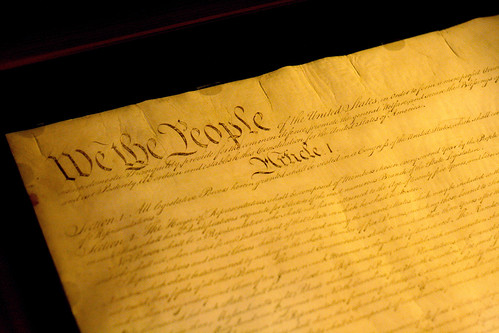
 The difficulty with removing legitimacy is that a thing must be allowed to grow and change, lest what it is now become but another foothold for those attempting to climb back to the days of yore in the assumption that older=better. (This is why the argument of a type of infallible, original intent interpretation of the U.S. constitution is the most perverse of all, attempting to be both historical and yet valid for all time.) If we consider a thing to be growing and alive, then this must imply that it will eventually pass out of being. Legitimacy should be considered according to what we want now and in the future, considering whether this tallies with the past. If it doesn't, why not? If not, do we do away with it?
Sunday, 1 January 2012
In your own time
Take the point made below about timescales, but reverse it. This is
the more accurate representation of how things stand in terms of
influence. Our own particular, partisan approaches require that things
be presented in the manner I first suggested, but the more exhaustive
reading indicates that the reverse is the case. It seems a minor point,
but it is crucial to the presentation of the argument. Here's why.
In this change of timescales throughout history, the fragmentation of time has taken place just as the individual has risen in importance. Fragmentation here isn't necessarily a bad thing. We can simply observe that from the introduction of clocks in villages and towns, allowing for a more precise breakdown beyond the pace of the ringing of church bells for services, up to the industrial age and the ascent of the pocketwatch (and all the social effects of this) ever smaller divisions of time have become possible. As a result, the grand timescales of dynasties and institutions are now seen as an aggregate of phases, of years and decades and centuries. As such, the long view is no longer regarded as an organic or collective entity unto itself.
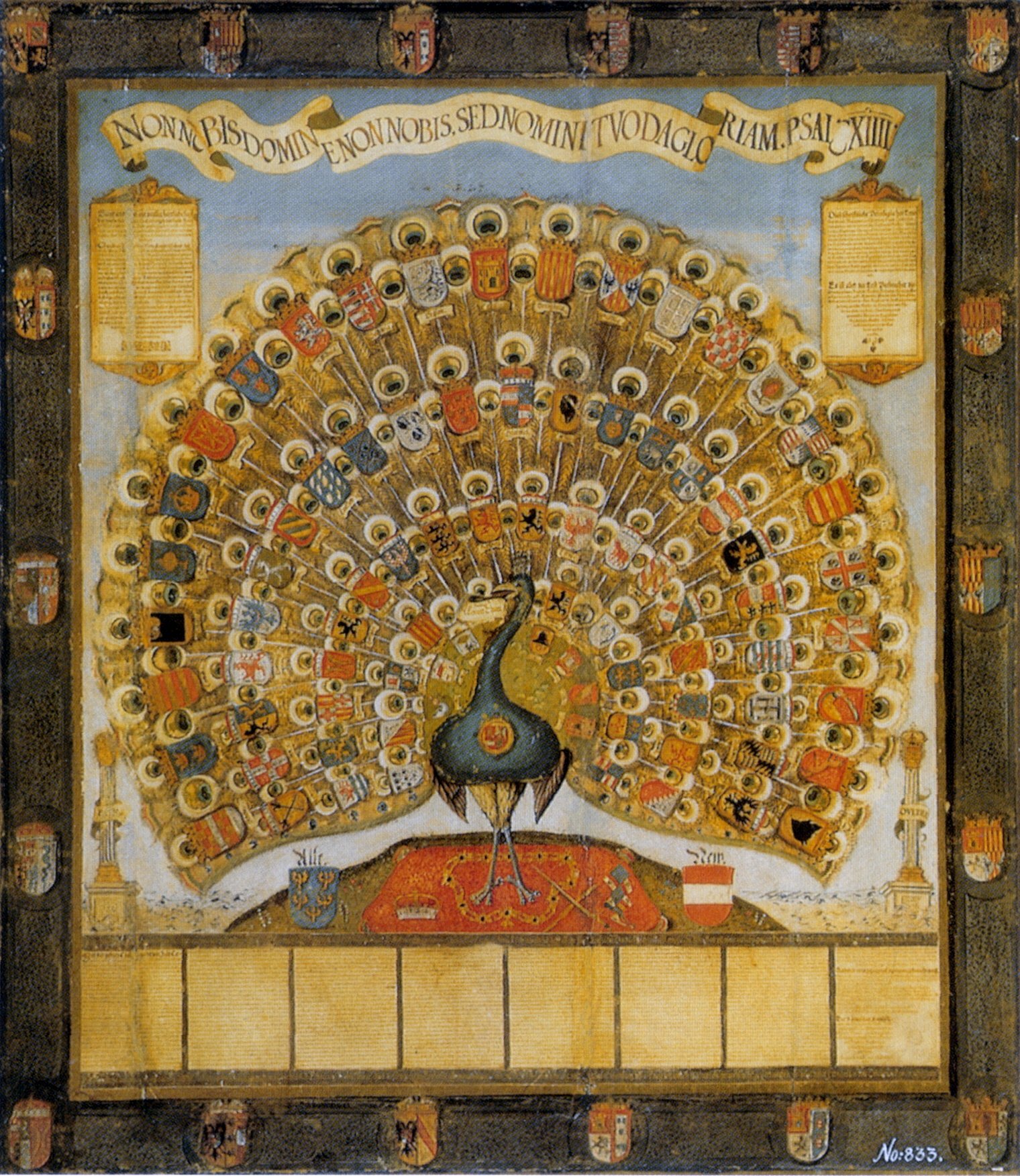
Consider this with regard to the phenomenon of European aristocratic dynasties. The Habsburg family (with all its various cadet branches included) claims to trace itself back to the 10th century, and from here they married their way to a continental supremacy that convulsed Europe in war and ruin over the centuries. It would not be fruitful to consider their history in terms of individuals, as our sense of time is different to theirs.
 Their
coat of arms is a testament to the various alliances, co-options,
annexations, marriages, and outright thefts that consolidate such a
dynasty as a supra-individual entity. In these terms, we must consider
the context of time and timescales. By leaving out the collective
entity of time, we miss something. In his "Idea for a Universal History from a Cosmopolitan Point of View",
Kant points out in his second thesis that "those natural capacities
which are directed to the use of [...] reason are to be fully developed
only in the race, not in the individual." Ignoring the use of the word
'race' here with it's chauvinistic implications, we see that there is
an awareness of the different implications of different timescales. One
is not superior to another, but has rather a different function.
Their
coat of arms is a testament to the various alliances, co-options,
annexations, marriages, and outright thefts that consolidate such a
dynasty as a supra-individual entity. In these terms, we must consider
the context of time and timescales. By leaving out the collective
entity of time, we miss something. In his "Idea for a Universal History from a Cosmopolitan Point of View",
Kant points out in his second thesis that "those natural capacities
which are directed to the use of [...] reason are to be fully developed
only in the race, not in the individual." Ignoring the use of the word
'race' here with it's chauvinistic implications, we see that there is
an awareness of the different implications of different timescales. One
is not superior to another, but has rather a different function.
In this change of timescales throughout history, the fragmentation of time has taken place just as the individual has risen in importance. Fragmentation here isn't necessarily a bad thing. We can simply observe that from the introduction of clocks in villages and towns, allowing for a more precise breakdown beyond the pace of the ringing of church bells for services, up to the industrial age and the ascent of the pocketwatch (and all the social effects of this) ever smaller divisions of time have become possible. As a result, the grand timescales of dynasties and institutions are now seen as an aggregate of phases, of years and decades and centuries. As such, the long view is no longer regarded as an organic or collective entity unto itself.
Consider this with regard to the phenomenon of European aristocratic dynasties. The Habsburg family (with all its various cadet branches included) claims to trace itself back to the 10th century, and from here they married their way to a continental supremacy that convulsed Europe in war and ruin over the centuries. It would not be fruitful to consider their history in terms of individuals, as our sense of time is different to theirs.
Tuesday, 27 December 2011
Timescales of hope and critique
In Pierre Teilhard de Chardin's "Some Reflections on Progress" from The Future of Man, we are confronted with a view of progress which is refreshing in the honesty with which it is proposed. This honesty and this hope are the best parts of Teilhard de Chardin because they are something that is all too alien to us critical secularists. As he says, "Whether from immobilist reaction, sick pessimism or simply pose, it has become 'good form' to deride or mistrust anything that looks like faith in the future."
What is refreshing here is that progress is taken as a given. On the conditions he sets out, it is, seen in the light of life as a "phenomenon of prodigious age", hundreds of millions of years in the making. What is then the next step, is to consider how such a timescale influences arguments about progress. In another essay in this collection ("The New Spirit, 1942") he describes "the immense travail of the world" as inevitably the reverse side of "an immense triumph." This is as troubling as all theodicies. One cannot an longer assert a crude polarity whereby suffering inevitably leads to its reverse; every manner of cruelty and hatred have been justified thus. This is the brutal catholic element of his thought which must be immediately jettisoned. This type of argument leads us to an optimism of which we have been rightly suspicious ever since Voltaire's critique of Leibniz, and even more so since the Holocaust.

We must be very careful when we take a long view, because this is the timescale of institutions and the state. This is how suffering and injustice is rationalized. It is the deus ex machina to which individuals appeal when they wish to silence other individuals. It is just as troubling in this guise as it is in the philosophical apparatus of Habermas's "consensus". We should probably start (as with Hans Georg Gadamer, pace Habermas, though this article correctly points out that the two positions are finally united somewhat by Paul Ricoeur) from what is, and proceed thence to where we actually wish to be. This might lead us to a nuanced and fluid mode of thought and action. It begins with our human all too human foibles, and takes us from there towards something better. This is a praxis of becoming.
By contrast, the position (one might say pose) of critique starts with negative criticism. It is already hoarse with the shrill haranguing of self-righteous denunciation. It takes no time to reflect, to consider, to discuss, to debate. It reifies critique. It is praxis still-born, strangled at birth by a flawed theory. This is not to suggest that critique has no place, ever. It is to show what influence a particular conception of time has on human thought. To say that an awareness of time stopped with the insights of phenomenology is misleading, and indeed has misled thought ever since. Returning to a more fundamental, even basic awareness of how time influences thought is a necessity.
Subscribe to:
Posts (Atom)