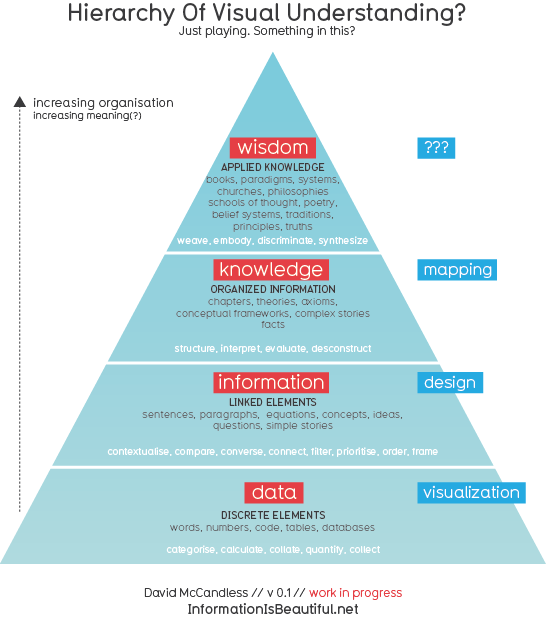
If an idea is presented, and elements of it are questioned in a manner that parries but does not thrust, if it is purely surface, does this in fact have any merit as criticism? A criticism ideally has a purpose, which is basically to be a form of troubleshooting. It must be specific, it must engage with the topic. To not do this is equivalent to saying "well I haven't used the software you developed, but it's probably rubbish" (we might call this The Troll's Refrain). Stand back and ask how does this help us to actually improve the idea. Even thinking 'us' is useful, because if there's a conversation, then there is a joint effort. David McCandless (author of the excellent Information is Beautiful) has a useful breakdown of how we think about the world, in the following pyramid:
In this, there is a progressive hierarchy of whittling out what is irrelevant, the old effort of separating the wheat from the chaff. This means that the bottom is a field somewhere, and so the top is presumably a Weetabix. Ideas are about turning information into knowledge, they move us from one level to the next. The non-criticism I am thinking of above seeks to move us back down, from knowledge back to information, or data. Instead of information, it focuses on noise.
There is a temptation in all debate to ask for greater and greater precision, but at the same time you have to step back and ask what level of perfection you want. If ideas are to be abstract, then they of course cannot account for everything. What we are searching for is a degree of functional 'robustness'. This is a term which Kevin Kelly makes continuous reference to in his writing (I am mainly thinking about 1995's Out of Control, which has dated far less than I would have expected), denoting that capacity for enduring networks of communication to cope with unpredictability. It is a nice antidote to management horseshit about "best practice" because it factors into its very structure that we start from least worst, and go on from there. We trade off a small degree of efficiency for a considerably greater degree of structural toughness. There will ever be noise, but not every blip is a threat to the entire system. Ideas are supposed to be solutions, and they are not to be rejected on aesthetic grounds. If it works it works, and from there we can begin the work of making our solution elegant.
Showing posts with label argument. Show all posts
Sunday, 8 January 2012
Ideas and criticism
Labels:
argument,
information,
Kevin Kelly,
networks
Wednesday, 4 January 2012
Too legit to quit
The obsession with legitimacy is the original recursive argument of political and philosophical debates. It sets off from an ideology of origination that skews all subsequent discussion and investigation. Thus in many ways the appeals to something's being self-evident is a stunningly original departure (much as the experience of reading Descartes and coming across the cogito ergo sum for the first time). It denies the dominion of the past, saying that our ever-present (N.B.) capacity for thought and invention is necessary, if not always sufficient.
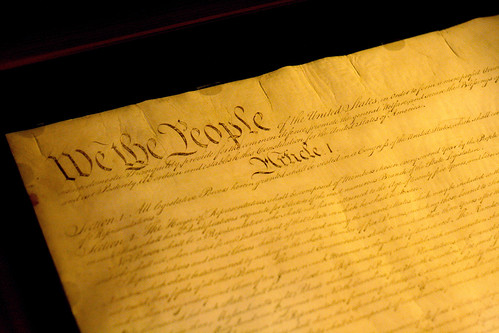
The difficulty with removing legitimacy is that a thing must be allowed to grow and change, lest what it is now become but another foothold for those attempting to climb back to the days of yore in the assumption that older=better. (This is why the argument of a type of infallible, original intent interpretation of the U.S. constitution is the most perverse of all, attempting to be both historical and yet valid for all time.) If we consider a thing to be growing and alive, then this must imply that it will eventually pass out of being. Legitimacy should be considered according to what we want now and in the future, considering whether this tallies with the past. If it doesn't, why not? If not, do we do away with it?
Sunday, 14 August 2011
Please give/read generously
The principle of charity is one of those difficult to maintain bits of basic conversational decency, namely the assumption our interlocutor is neither a moron nor evil. All too frequently, however, it is the first piece of excess weight to be jettisoned in the high-speed game of debate. Calm and considered becomes fast and dirty. It is the triumph of a certain type of rhetoric over reason, and the ground for all ad hominem attacks. What I wonder is whether there is room for some middle ground, or some manner whereby we can attack...justifiably.
The first need not be the face-saving, third-way, risk-averse, Swiss-inspired take on argument. Perhaps the reductio ad absurdum is one way for this to take place, since in this way we accept our opponent's terms, and take them to a final conclusion that in its extremity whiplashes back in a shockwave of ludicrousness on the starting premises. This too, however, involves a certain suspension of the principle of charity, because our partner in this discussion (which is what we should probably consider our opponent to be) can protest that they did not intend for their position or argument to have the scope which we may have imputed. The second could be a kind of "just war doctrine" for argument.
I believe that the best route is to start with a technological, network approach, allowing this to inform our discussions and arguments. As such, if something (an idea, critique) creates more information or even knowledge, then it is valid. If it is posturing, cynical, opportunistic, then it is not. Only that which is constructive (or not overtly destructive) is valid. Cynicism and the "cool" attitude of neo-conservative, laissez faire post-modernism is a performance, an act of being "knowing" rather than the effort to created knowledge.
The first need not be the face-saving, third-way, risk-averse, Swiss-inspired take on argument. Perhaps the reductio ad absurdum is one way for this to take place, since in this way we accept our opponent's terms, and take them to a final conclusion that in its extremity whiplashes back in a shockwave of ludicrousness on the starting premises. This too, however, involves a certain suspension of the principle of charity, because our partner in this discussion (which is what we should probably consider our opponent to be) can protest that they did not intend for their position or argument to have the scope which we may have imputed. The second could be a kind of "just war doctrine" for argument.
I believe that the best route is to start with a technological, network approach, allowing this to inform our discussions and arguments. As such, if something (an idea, critique) creates more information or even knowledge, then it is valid. If it is posturing, cynical, opportunistic, then it is not. Only that which is constructive (or not overtly destructive) is valid. Cynicism and the "cool" attitude of neo-conservative, laissez faire post-modernism is a performance, an act of being "knowing" rather than the effort to created knowledge.
Your argument is invalid.
Well, all I can hope is that my interlocutors would start with the premise that if I managed to somehow feel my way through the fug of idiocy, to mash my troglodytic hands against a keyboard for long enough to eventually produce something that borders on grammatical consistency and logical intelligibility then that maybe, just maybe, I am not some sort of satanic imbecile hell-bent on the destruction of civilization and indeed the universe itself via the twin idols of incompetence and depravity. I should be so lucky.
Wednesday, 13 July 2011
Leave it to beaver.
Why is it somehow still valid to make statements along the lines of "X is what makes us human"? Whether that X is tool-use, or a sense of right and wrong, or opposable thumbs doesn't make much difference; it's pretty clear that you can change this slightly to say that X is "what makes me human", and making human is not much better than "what I want to talk about".
Usually when I come across this in a book or an article, there is some caveat, so that though there is room to introduce some other point (as an example, for tool-use, there might be a discussion of beavers building dams, or some other non-human example of technology), this is more or less dismissed with the old medieval philosophy method whereby if you meet a difficulty, you make a distinction. So now there is real tool-use, and whatever beavers do. Silly beavers.
How far are we from a proper estimation of what it means to be human that we have to introduce some sort of test? Testing inevitably implies ranking and exclusion, so why do this? Whence the sense of being threatened by beavers, dolphins, or whatever other example of non-human intelligence that we meet?
That's just one type of objection to the above form of quasi-philosophical statement. If you transpose some of the above terms, you get a sense of just what's up. Suppose somebody in a conversation said, "Well, X is fundamentally what makes me a man", you might well question their attitude towards their own self-worth, women, gender, sexuality, and all that. What masquerades as some attempt to get at the essence of a thing in actuality points away from it. This is why analytic philosophy cultists have issues with what Ayer saw fit to dismiss (and many still do) as 'metaphysical' statements. They achieve the exact opposite of their purported intent. Rather than getting to the 'essence' (yeah, whatever that is), they instead blithely assert.
Subscribe to:
Posts (Atom)