Sunday, 29 January 2012

Tuesday, 24 January 2012
American films beginning with "American"
A recent discussion of Shame led to one of those conversations this not alien to me. I said that I hadn't seen the film, but had read that it was a kind of American Psycho for the teens ... or whatever we are calling this decade (consider other compelling definitions of Shame here and here). Now, sometimes these comparisons are superficially illuminating. So we might say that The Social Network is the Citizen Kane for Generation Y. Something like this is a stepping stone to getting to another point in the conversation - they are a slimy, moss covered rock on which we might precariously balance as the deluge of half-formed opinions and almost-thoughts gush past. They are a way of saying "X is the new black". They are a conversational conceit, to be picked up and dropped as required. Sometimes, however, I don't know when to drop it. Years of having such conversations (starting in their Ur-form when I worked in a video shop) means I find it all too easy to get swept away, and what is a blog good for if it isn't a black box to transform a drunken idea into a tendentious argument. You need some structure for this if it is to be useful, however, so the matrix of my model is the following:
Monday, 23 January 2012
Outsourcing the self
If social networking is creating a new ecology of communication, how is it doing so? It is effectively a way of outsourcing our connections with other people, whereby we no longer need to worry about doing anything so vulgar as actually having to remember birthdays, or ages, or where you met them, or...in certain cases, what their name is. The upside to this should be that by outsourcing our memory in this manner, then we should have more time free to do more things with these people. We don't need to write a letter, or even an email. Perhaps we think we can just send a message, and all is well. The problem is that this theoretical free time is a black hole. Most have had that that experience of trawling Facebook for what we think is just a few minutes, then *snap* you're back in the room and two hours have passed. How is this? Well, as with all technologies, there are benefits and there are drawbacks. This form of communication is low-grade, and labour-intensive. We may get more connected, but this means more active effort is needed maintain these connections.
Wednesday, 18 January 2012
Perfect internet, algorithms and long tails
"There is no standard Google anymore", "invisible, algorithmic editing of the web", "The internet is showing us a world we want to see, not what we need to see." This is what we all glory in, that whatever we want is available to us, the long tail in action. As in the post below, however, the tail has to be attached to something. The long tail says that you can profit from deviating from a norm, but the result of the algorithms that choose for us is that new norm are created. Thus we have the phenomenon of your Facebook page becoming an echo chamber. Such algorithmic editing has swallowed wholesale the arguments behind generation me, as well as the result of the culture wars where all norms are negative. What we have, then, is software as a crypto-morality. "There cannot be such a thing as a norm", this narrative tells us, "because nobody has a right to tell me what's normal!" There is a confusion in our conceptual apparatus, because a quantitive norm is being interpreted as a qualitative norm. There is a case where there is a cross-over, as Hegel tells us, but basic exchange of information requires this standard in terms of brute numbers. There is not a political or ethical agenda to this concept of the numerical norm.
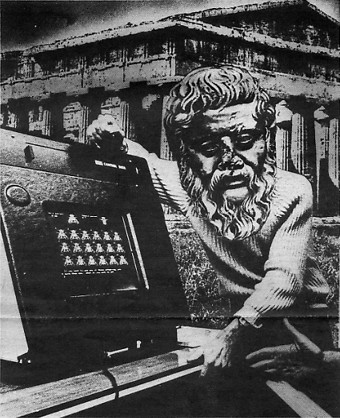
The assumption behind algorithmic editing is that there is a perfect search result. It is a cybernetic version of Plato's forms. There cannot be such a perfect internet experience, however, and we mislead ourselves in even imagining it is impossible. Perfect, in the sense of Lt. perfectus implies completion, of something being finished. This is nonsense, and so perhaps the ideology of perfection that underlies the thought and practice of information technologies should be reminded of the irreducible reality of noise, of that which does not necessarily communicate a message, but without which the message cannot be communicated. We need to be able to go for a stroll with no particular destination in mind. We need that element of play in the hard sense, not hippy-dippy "y'know like whatever man". StumbleUpon curiously tries to inhere play into an algorithm, but for me it lacks that spookily magic sense of achievement when you find something that hasn't been linked by a thousand others already. We must realise there is a fundamental and structural contradiction in terms by attempting to make our online environment perfect for us in all ways because this leads to the isolation everyone on their own personal desert island. This simply establishes us in our own limits. Where then do we meet communally? Where do we have arguments? Where do we hear new stories, or jokes, or gossip? We need to have a norm from which we deviate, we need to have a same for there to be difference.
See also, Web 3.0 : http://en.wikipedia.org/wiki/Semantic_Web
Tuesday, 17 January 2012
Is open source inevitable? II
[If open source is to have its day, some implications must be examined]
Technologies of privacy:
Transition away from previous economic models. Manufacturing and the mass ownership of capital has been on the wane for generations. Consider the MIT model of spinning-off industries. According to this study "Entrepreneurial Impact: The Role of MIT", if one were to regard companies developed by MIT alumni, collectively they would form the 11th largest economy in the world. Technologies must be proven, thus they must be peer-reviewed as well as tested by the market. If everybody can use the same ideas (goodbye proprietary anything), if open source and the intellectual commons get their day, then the matter of 'economic viability' is set aside in favour of "technical viability" and 'environmental viability'. The new models will have to incorporate recognition that there are diseconomies of scale, and what we called economies of scale were all too often a fetishization of size. This is a realization from the realm of network theory, which brings the long tail to bear on our everyday lives. It is not merely a niche element - the long tail is not long tail, as it were. (E.F. Schumacher had an intimation of this in his collection of essays, Small is Beautiful.)

Technologies of privacy:
- Old style : passive, reactive, the default position.
- New versions?: Opt-in, active privacy; specifically designed ways of deciding what we share, and with whom.
Transition away from previous economic models. Manufacturing and the mass ownership of capital has been on the wane for generations. Consider the MIT model of spinning-off industries. According to this study "Entrepreneurial Impact: The Role of MIT", if one were to regard companies developed by MIT alumni, collectively they would form the 11th largest economy in the world. Technologies must be proven, thus they must be peer-reviewed as well as tested by the market. If everybody can use the same ideas (goodbye proprietary anything), if open source and the intellectual commons get their day, then the matter of 'economic viability' is set aside in favour of "technical viability" and 'environmental viability'. The new models will have to incorporate recognition that there are diseconomies of scale, and what we called economies of scale were all too often a fetishization of size. This is a realization from the realm of network theory, which brings the long tail to bear on our everyday lives. It is not merely a niche element - the long tail is not long tail, as it were. (E.F. Schumacher had an intimation of this in his collection of essays, Small is Beautiful.)

How do we then differentiate between old and new? It becomes a matter of service. Will digital mean that we are all eventually a part of the service economy? We may be able to set our businesses apart according to how we deal with our customers. It may be a matter of approach rather than cost. A fully open source world, with respect for the intellectual commons, is utopian. Too much seems to stand in its way, but elements of this can be used to consider alternatives to developing nations making the mistakes that the industrial and post-industrial nations have made. Consider the principle of the long tail applied to national economies. Of course there will factors that lead a country to be wealthy by virtue of some natural resource, as long as unsustainable practices are maintained, but an open principle towards information will in theory allow innovation to take place anywhere. We see this in the emergence of 'regional hubs' and 'centres of excellence', but the best example yet, in terms of something that will actually last (unlike Dubai), is Singapore. CNN has fifty reasons to account for this (about 20 are compelling, but that's enough for me). For long enough have people considered the first part of McLuhan's "Global Village". We need now to give greater attention to the 'village' part. That is the locus of differentiation, and of what we can manage, to make our actions environmentally and socially sound.
Towards a definition of technology
One popular view holds that the human mind truly came into its own via a "rewiring" (Kevin Kelly in Out of Control, online version here). With this there was an extension of the brain beyond its grossly physical, biological limitations. Technology serves body, body serves brain, with brain and body as a multiplicity serving the genes in the final reckoning. Technology is the overcoming of limits - of whatever kind. That which overcomes limits in whatever mode thus serves us as a technology. We should be able to extend such a provisional definition beyond hammers and wheels and machines. Accordingly, in the most serious sense, art is a technology. A poem, a painting, a dance is a recalibration of purely crude literalism (as a kind of tyranny of an ontology of representation, of reality as a 'given' rather than as a 'made'). Art can move us beyond these assumptions which we have forgotten were once new.
 With this, considering all things in terms of limits and our overcoming them, does this open the door to new analyses? Are there examples where it can be said not to apply? In technological terms, what is the function of this definition, and can it tell us anything new? It is basically an engineer's-eye-view, whereby a technology is a solution to a problem. Its function is to solve a problem, the problem being a limit which has been encountered. From this definition, some fascinating implications follow. Technology at this basic level of analysis appears to us as being self-perpetuating. Each technology brings with it a new set of problems, which in turn requires new sets of solutions, and on, and on...literally ad infinitum. We can say then that the first characteristic of technology is that it is autocatalytic. In chemical terms, a reaction is chemically autocatalytic if its product is also the catalyst for further reactions. This is so for technology and as such it manifestly is a source and product of feedback. Edward Tenner examines this in detail in terms of "revenge effects". I am not taking an ethical stance on the matter one way or the other, as Tenner's thesis requires of him. Nor am I suggesting this is simply a corollary of technology. I am saying that this feature is structurally integral to all technologies. (For an alternative overview with an ethical focus, see "The Unanticipated Consequences of Technology" by Tim Healy.)

"Ah, but a man's reach should exceed his grasp,
Or what's a heaven for?..."
The human being is that creature par excellence whose reach exceeds its grasp, except it is the cognitive reach that exceeds the physical grasp. Technology is the attempt to bridge the two. We will never, in our present form, have the steady-state evolutionary form that living fossils such as the coelacanth; in them, reach and grasp coincide perfectly. Homo sapiens, in contrast, are necessarily an imperfect solution to the problem of life (if this can be said without woe-is-us connotations), the problem of adaptation to an environment. The reason for this is that by being sapiens we continually alter our environment such that no steady state becomes possible. We are implicated. Each new product of our mind that enters the world as either a physical or a mental technology is a solution that creates new problems. The cycle cannot stop.


Problem: solved.
If we return to the human mind, and consider the following. The rewiring that brought about consciousness brought about the ability to think in terms of what is not present, in time and space. It allowed for planning for a harsh winter. It allowed one to consider the potential benefits and dangers the next valley over. It escapes what I above called crude literalism. There are lines in Robert Browning's "Andrea del Sarto" that capture this:"Ah, but a man's reach should exceed his grasp,
Or what's a heaven for?..."
The human being is that creature par excellence whose reach exceeds its grasp, except it is the cognitive reach that exceeds the physical grasp. Technology is the attempt to bridge the two. We will never, in our present form, have the steady-state evolutionary form that living fossils such as the coelacanth; in them, reach and grasp coincide perfectly. Homo sapiens, in contrast, are necessarily an imperfect solution to the problem of life (if this can be said without woe-is-us connotations), the problem of adaptation to an environment. The reason for this is that by being sapiens we continually alter our environment such that no steady state becomes possible. We are implicated. Each new product of our mind that enters the world as either a physical or a mental technology is a solution that creates new problems. The cycle cannot stop.
Saturday, 14 January 2012
Fantasy and the possible
"Yet the invocation of magic by modern fantasy cannot recapture this fascination, but is condemned by its form to retrace the history of magic's decay and fall, it's disappearance from the disenchanted world of prose, the 'entzauberte Welt', of capitalism and modern times."
- Fredric Jameson, Archaeologies of the Future: The desire called utopia and other science fictions [71]
 The major works of serious literary fantasy reflect upon this concept of magic-as-waning (John Crowley, Sheri Tepper, Susanna Clarke, et al.). How can this magic be linked properly to its reserve of power, namely human creative power? This creative power has become alienated, and the dialectic of enlightenment applies here just as much to religion because of fantasy's secular-thus-literary realm of exploration. Well, it ought to explose, but more often the literary fantasy (or just plain fantasy, the literary mulls things over more profoundly than this) will at least reflect on its own alienation.
 John Crowley is a prime example of this in both his masterpiece Little, Big as well as the Ægypt cycle. Susanna Clarke upsets our expectations by positing a final waxing of magic rather than its disappearance from the world, which emphasises all the more how the magical truly has waned from our world and even our imaginations. It is striking that Clarke's Jonathan Strange and Mr. Norrell was so acclaimed, but what is even more striking was that its reception seemed always to be accompanied by a note of surprise that this, a book that involved magic, was not hopelessly puerile. We could, this raised-eyebrow subtext suggested, actually enjoy something that wasn't on the Eastenders end of the realism continuum, yet that was not of the dwarves and unicorns variety. It was becoming acceptable to note that there was indeed a literary fantasy that could be read by those coming from the literary vector rather than the other way round, coming from fantasy but being discerning. Previously it was Borges and Calvino who were in this non-purely-realism citadel (acceptable, as Gore Vidal notes regarding another topic, because they don't write in English, which we might call the language of instrumental reason), but others have joined them. One would hope, however, that as fantasy became literary, non-discussions as to the artistic merit of previous bastions should really become moot (such that we can say J.R.R. Tolkien was not "snubbed", he simply didn't deserve the Nobel).
 If we can reflect on the passing of magic in a fantasy text, is this more than a shallow generic narcissism? Does it point to an intriguing approach whereby the old Freudian idea allows magic to be regarded as wish-fulfillment, rather than having little to do with the "thinking through of the dialectic" that Fredric Jameson is proposing. The alienation of magic has much to do with the alienating power of technology and reason, how these forces of industry and enlightenment are regarded as inhuman, rather than as the ne plus ultra of humanity. We might make a connection here with Arthur C. Clarke's "Three Laws":
- Fredric Jameson, Archaeologies of the Future: The desire called utopia and other science fictions [71]



- When a distinguished but elderly scientist states that something is possible, he is almost certainly right.
- When he states that something is impossible, he is very probably wrong.The only way of discovering the limits of the possible is to venture a little way past them into the impossible.
- Any sufficiently advanced technology is indistinguishable from magic.
Thursday, 12 January 2012
Inevitability of irony
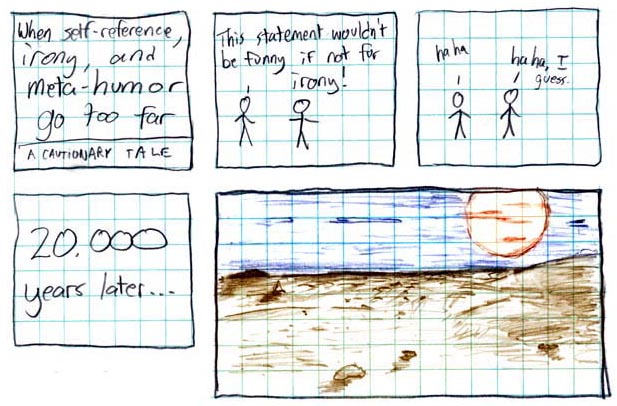
There is a structural inevitability to all discourse, such that as it progresses, it inheres learning within itself, creating more, growing, until ultimately it begins to query its conditions of possibility. This is irony, and it is not necessarily purely out of some sort of cognitive paralysis, as irony is all too often dismissed. It is not some disease of modern thought. It is a part and parcel of all discourse. It is in fact a permanent fact of all expert systems (Fernand Hallyn, The Poetic Structure of the World: Copernicus and Kepler, pp. 20-2), literature, and indeed to the vast complex of a culture's discourse in toto. Irony is an effort to reconsider the structural presuppositions that a discourse relies upon, most likely because of a perceived need for improvement and an awareness that the discourse one is using is coming up to the limits of its usefulness. It is the intuition that a discourse could operate better, could be more precise and efficient.
 Often irony proceeds as a knowing and saying too much, as a show that one has mastered the vast amount of materials available in a given field (one cannot be ironic without this overflowing of knowledge), to the extent that jokes, puns and other diversions not only become possible but may seem necessary to maintain interest in a given topic. With this, interest ceases to be "constructive", and rather becomes a performance, and aesthetic. One is 'knowing' rather than knowledgeable. If we consider the pyramid of David McCandless below, it seems that in irony we slide back down from knowledge into information. We no longer have coordinating ideas to pull information together into a coherent structure. Irony is a kind of decoherence rather than incoherence. If we use the analogy of the stock market, then irony is a symptom of massive overvaluation, and any backlash against it such as "The New Sincerity" (see here for the neutered and here for the enthusiastic versions) is a crash, and an inevitable one (or necessary depending on your view). What emerges after this is that which has run a gauntlet of functionality, as it has demonstrated its worth via its robustness in the onslaught of critique.
Wednesday, 11 January 2012
The Whig interpretation of information: Is open source inevitable? I
The following is an attempt to trace some of the outlines of an element of the ideology of technology, it is not a detailed sociological analysis. The standard political model favoured by many interested in information technologies point to the supposed inevitability of openness. It is a techno-libertarianism that hovers over all discussion, our standard right-on refrain. Certainly it can be regarded as a goal, but more along the lines of a regulating ideal, rather than a Five Year Plan. This is a polite way of saying we don't back any of this up with action. The argument for openness is in its essence a historical one, which notes that once there had been an information technology that somebody attempted to control, there followed a breakdown of this control, with a free and open exchange following. I draw a parallel with Herbert Butterfield's thesis of the Whig interpretation of history, which recasts past history with a view to the present. Accordingly, an apparent chain of progress can be easily discerned from the chaos of the past, if you know what you are looking for. Such is the confirmation bias. This, however, misses the structures through which information is made available, those other technologies that have an influence - and there are many of them. In one set of terms this is how information and indeed an entire information technology is encoded. We need to confront the problem of context.
 Reading the above outline (and I also think of Stephenson's Cryptonomicon mentioned previously) we must see that not all information is (or should be?) available as the ideal might hold. Indeed, openness is not a default. Were it so, should codes from history spontaneously decay into sense via some entropy of coherence? Openness is not a default because encoding is a technology. So too must we consider its recoding into openness (not decoding, which is then a contradiction in these terms). The myth of openness is based in reality, as all myths are, but it forgets TANSTAAFL, there ain't no such thing as a free lunch. This is a governing principle of information theory as much as it is thermodynamics.
According to the model I am proposing to dismiss, communication works as follows. whereby we speak openly to communicate a message, and then write this down so it is intelligible to both sides, and then it is encrypted. What this picture (or straw man, if I am totally off the wall) does not allow is that which a thoroughgoing techno-functionalist position can account for, namely the following. Speech is a form of encoding, long accepted and widely available, but a technology nonetheless. So too is writing. So too is transforming that writing into a second level of sense, namely an encoded (recoded according to my view) piece of writing, though of course it need not be writing. Codes do not degrade, they are broken. We invent a technology to extract sense from the encoded text, and thus we make it appear as though we have reversed the arrow of time, stepping into a past where the message we seek had not yet been put into that secret code which cloaks it. It almost appears as though we got that free lunch. We did not. If encryption is but another form of encoding. Encryption is as much a technology as is any other encoding. Openness too is a technology.
Is this an invalid conflation of discussing open source in the same breath as encryption? I do not believe so, and I do not compare them say they are equivalent, who cares. I do not propose indifferentism. I am saying that because there is no arrow of inevitable openness, one must actively fight for openness (with open source but the latest example of this). Pace the egotism of Julian Assange, we cannot have a knee-jerk ideology where we have a right to know everything at all times. Sissela Bok's Secrets from 1983 (currently out of print, but a contemporary New York Times review gives a fair outline) examines the issues surrounding secrecy, and notes that openness in the realm of science (which is broadly speaking where we might place the open source movement) has quite a different function to the role of secrecy in investigative journalism, whistleblowing, undercover police operations, and secrets of state (these and other issues each get their own chapter).

See also, "Is open source inevitable? II"

According to the model I am proposing to dismiss, communication works as follows. whereby we speak openly to communicate a message, and then write this down so it is intelligible to both sides, and then it is encrypted. What this picture (or straw man, if I am totally off the wall) does not allow is that which a thoroughgoing techno-functionalist position can account for, namely the following. Speech is a form of encoding, long accepted and widely available, but a technology nonetheless. So too is writing. So too is transforming that writing into a second level of sense, namely an encoded (recoded according to my view) piece of writing, though of course it need not be writing. Codes do not degrade, they are broken. We invent a technology to extract sense from the encoded text, and thus we make it appear as though we have reversed the arrow of time, stepping into a past where the message we seek had not yet been put into that secret code which cloaks it. It almost appears as though we got that free lunch. We did not. If encryption is but another form of encoding. Encryption is as much a technology as is any other encoding. Openness too is a technology.
Is this an invalid conflation of discussing open source in the same breath as encryption? I do not believe so, and I do not compare them say they are equivalent, who cares. I do not propose indifferentism. I am saying that because there is no arrow of inevitable openness, one must actively fight for openness (with open source but the latest example of this). Pace the egotism of Julian Assange, we cannot have a knee-jerk ideology where we have a right to know everything at all times. Sissela Bok's Secrets from 1983 (currently out of print, but a contemporary New York Times review gives a fair outline) examines the issues surrounding secrecy, and notes that openness in the realm of science (which is broadly speaking where we might place the open source movement) has quite a different function to the role of secrecy in investigative journalism, whistleblowing, undercover police operations, and secrets of state (these and other issues each get their own chapter).
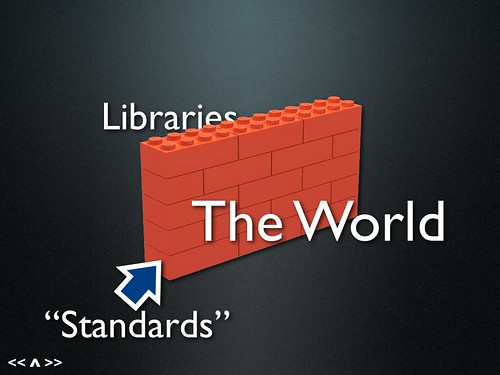
Lego: a threat to open source.
Open source as an idea as well as a movement needs to realise that because it is inextricably linked with trade and corporate secrecy (another chapter of Bok's), then for this to be more than a flash-in-the-pan, it must become part of an ecology of openness, interacting with problems such as copyright, and the knowledge economy. Indeed, regarding the former, there has been for some time an awareness of this, found in the idea of copyleft, which enacts a philosophy of pragmatic idealism, as outlined by Richard Stallman. This is not the time for micropolitics, but for a statement of intent, a declaration whereby we might make our unthought and unspoken assumptions real. One more effort, technologists, if you would become opens source!See also, "Is open source inevitable? II"
Sunday, 8 January 2012
Ideas and criticism
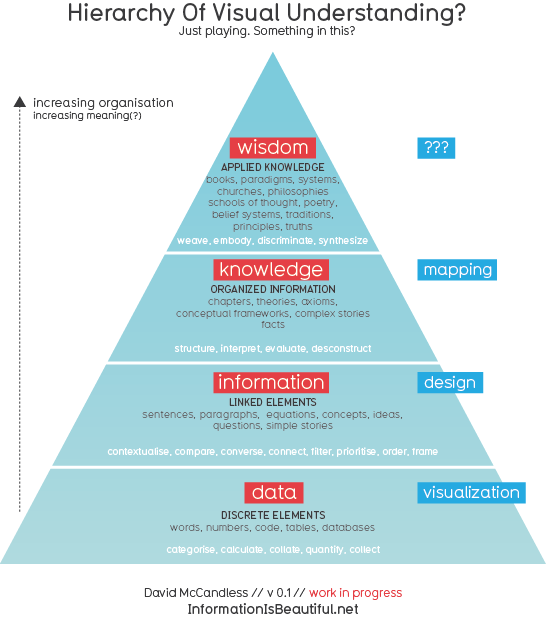
If an idea is presented, and elements of it are questioned in a manner that parries but does not thrust, if it is purely surface, does this in fact have any merit as criticism? A criticism ideally has a purpose, which is basically to be a form of troubleshooting. It must be specific, it must engage with the topic. To not do this is equivalent to saying "well I haven't used the software you developed, but it's probably rubbish" (we might call this The Troll's Refrain). Stand back and ask how does this help us to actually improve the idea. Even thinking 'us' is useful, because if there's a conversation, then there is a joint effort. David McCandless (author of the excellent Information is Beautiful) has a useful breakdown of how we think about the world, in the following pyramid:
 In this, there is a progressive hierarchy of whittling out what is irrelevant, the old effort of separating the wheat from the chaff. This means that the bottom is a field somewhere, and so the top is presumably a Weetabix. Ideas are about turning information into knowledge, they move us from one level to the next. The non-criticism I am thinking of above seeks to move us back down, from knowledge back to information, or data. Instead of information, it focuses on noise.
 There is a temptation in all debate to ask for greater and greater precision, but at the same time you have to step back and ask what level of perfection you want. If ideas are to be abstract, then they of course cannot account for everything. What we are searching for is a degree of functional 'robustness'. This is a term which Kevin Kelly makes continuous reference to in his writing (I am mainly thinking about 1995's Out of Control, which has dated far less than I would have expected), denoting that capacity for enduring networks of communication to cope with unpredictability. It is a nice antidote to management horseshit about "best practice" because it factors into its very structure that we start from least worst, and go on from there. We trade off a small degree of efficiency for a considerably greater degree of structural toughness. There will ever be noise, but not every blip is a threat to the entire system. Ideas are supposed to be solutions, and they are not to be rejected on aesthetic grounds. If it works it works, and from there we can begin the work of making our solution elegant.

Saturday, 7 January 2012
It's Kant...but IN SPACE!: or, MC Hammer versus Missy Elliot.
"We here propose to do just what Copernicus did in attempting to explain the celestial movements. When he found that he could make no progress by assuming that all the heavenly bodies revolved round the spectator, he reversed the process, and tried the experiment of assuming that the spectator revolved, while the stars remained at rest. We may make the same experiment with regard to the intuition of objects."
- Immanuel Kant, Critique of Pure Reason, Preface to the Second Edition [B xv], Meiklejohn trans.
In any discussion of either Kant of the philosophy of the Enlightenment, this idea is one of the first we encounter. It is either noted simply as his "Copernican revolution", or it is glossed in terms of scientistic hubris and a dangerous precedent for thought. I had regarded it more as the latter the first time I encountered this text, but upon reading it now, it has a decidedly different tone, one which causes me to silence the part of me that recognises and acknowledges metaphor when I encounter it. Instead, I think I am only just now getting what Kant is actually saying here. This language is considerably less figurative than I had at first thought (I may simply be slow, I make no claims to novelty here). It is not simply a rhetorical flourish; the extended metaphor of the successive governments of the queen of the sciences in the first preface illustrates that, at any rate, if Kant goes to the effort of devising a metaphor, he'll get his thaler's worth. Admittedly, he is not regarded as a master stylist, and if ever the joke "I am sorry for this being so long, but I hadn't the time to make it any shorter" applied to a philosopher, well... Kant was it.


- Immanuel Kant, Critique of Pure Reason, Preface to the Second Edition [B xv], Meiklejohn trans.
In any discussion of either Kant of the philosophy of the Enlightenment, this idea is one of the first we encounter. It is either noted simply as his "Copernican revolution", or it is glossed in terms of scientistic hubris and a dangerous precedent for thought. I had regarded it more as the latter the first time I encountered this text, but upon reading it now, it has a decidedly different tone, one which causes me to silence the part of me that recognises and acknowledges metaphor when I encounter it. Instead, I think I am only just now getting what Kant is actually saying here. This language is considerably less figurative than I had at first thought (I may simply be slow, I make no claims to novelty here). It is not simply a rhetorical flourish; the extended metaphor of the successive governments of the queen of the sciences in the first preface illustrates that, at any rate, if Kant goes to the effort of devising a metaphor, he'll get his thaler's worth. Admittedly, he is not regarded as a master stylist, and if ever the joke "I am sorry for this being so long, but I hadn't the time to make it any shorter" applied to a philosopher, well... Kant was it.

Fail.
He is not attempting to point out that he is on the same level of awesomeness as Copernicus, nor is he attempting to arrogate some scientific kudos for critical philosophy. He is rather no more than noting that he is effecting a similar change of perspective. I assume that if one knows the name Copernicus, one understands that he was responsible for kicking off the modern shift in science away from an Aristotelian/Ptolemaic or geocentric conception of the universe (where the Earth stands at the centre, and everything else wheels off elsewhere with its epicycles and epicycles of epicycles &c.) to the modern, heliocentric model. With Copernicus and those who followed, we were no longer it. We were no longer the centre of the universe, except in our own feverish egotistical imaginings. 
Kantian.
Another of Kant's famous sentences, and one that he arranged that should be engraved on his gravestone is the following: "Two things fill the mind with ever-increasing wonder and awe, the more often and the more intensely the mind of thought is drawn to them: the starry heavens above me and the moral law within me." The former is what concerns me more, even though the moral element is what gets more press (as much as transcendental critique gets attention these days). Nature and science were hugely important to Kant, and he was no mere dilettante. Accordingly, he had a proper understanding of what Copernicus had done. Where before astronomy had put humanity at the centre, the new heliocentric model did away with this, and in the process exposed our limitations. We did not know everything. Aristotle was not correct in all things (this was a serious epistemological threat to the church, thus the Inquisition requesting the pleasure of Galileo's company).
Basically Kant does the same thing for philosophy as Copernicus: he put our conceptual model down on the page, flipped it, and reversed it. He pointed out that our assumptions about how we engage with reality are what mislead us, and so instead of doing what philosophy and metaphysics had been doing for so long (namely "when you encounter a problem, make a distinction") is the wrong approach. As Abraham Maslow said, if you only have a hammer, you tend to see every problem as nail. One way of putting it might be that Kant wanted us to reconsider not just our conceptual toolbox, but also the problem/solution dichotomy. By placing our knowledge and the attempt to critically think through our means of knowing in the context of the universe as a whole with us as but an element, the possibility of an entirely new perspective and way of thinking presents itself.
Wednesday, 4 January 2012
Too legit to quit
The obsession with legitimacy is the original recursive argument of political and philosophical debates. It sets off from an ideology of origination that skews all subsequent discussion and investigation. Thus in many ways the appeals to something's being self-evident is a stunningly original departure (much as the experience of reading Descartes and coming across the cogito ergo sum for the first time). It denies the dominion of the past, saying that our ever-present (N.B.) capacity for thought and invention is necessary, if not always sufficient.
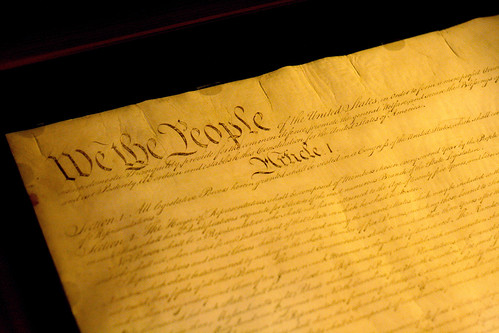
 The difficulty with removing legitimacy is that a thing must be allowed to grow and change, lest what it is now become but another foothold for those attempting to climb back to the days of yore in the assumption that older=better. (This is why the argument of a type of infallible, original intent interpretation of the U.S. constitution is the most perverse of all, attempting to be both historical and yet valid for all time.) If we consider a thing to be growing and alive, then this must imply that it will eventually pass out of being. Legitimacy should be considered according to what we want now and in the future, considering whether this tallies with the past. If it doesn't, why not? If not, do we do away with it?
Sunday, 1 January 2012
In your own time
Take the point made below about timescales, but reverse it. This is
the more accurate representation of how things stand in terms of
influence. Our own particular, partisan approaches require that things
be presented in the manner I first suggested, but the more exhaustive
reading indicates that the reverse is the case. It seems a minor point,
but it is crucial to the presentation of the argument. Here's why.
In this change of timescales throughout history, the fragmentation of time has taken place just as the individual has risen in importance. Fragmentation here isn't necessarily a bad thing. We can simply observe that from the introduction of clocks in villages and towns, allowing for a more precise breakdown beyond the pace of the ringing of church bells for services, up to the industrial age and the ascent of the pocketwatch (and all the social effects of this) ever smaller divisions of time have become possible. As a result, the grand timescales of dynasties and institutions are now seen as an aggregate of phases, of years and decades and centuries. As such, the long view is no longer regarded as an organic or collective entity unto itself.
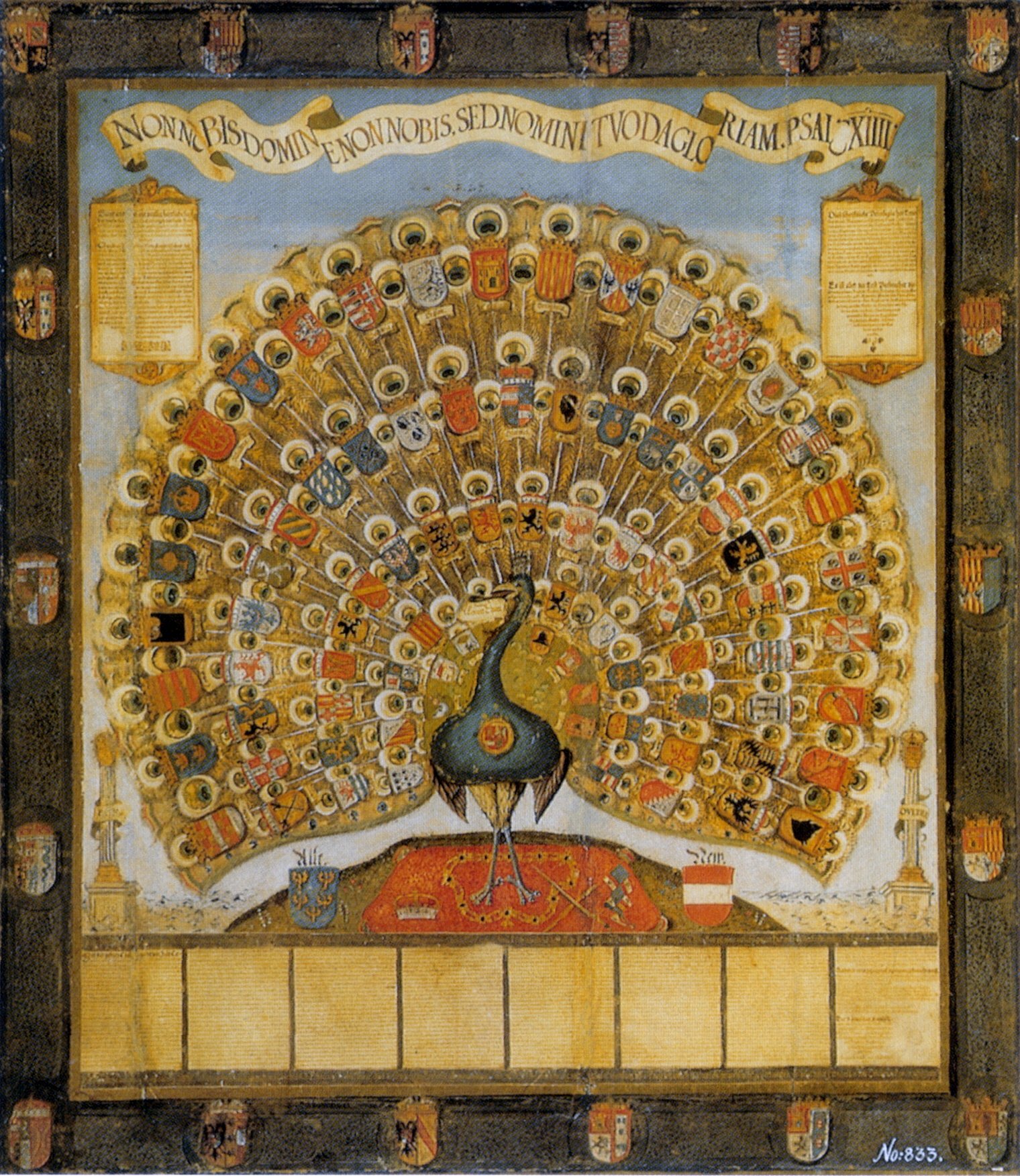
Consider this with regard to the phenomenon of European aristocratic dynasties. The Habsburg family (with all its various cadet branches included) claims to trace itself back to the 10th century, and from here they married their way to a continental supremacy that convulsed Europe in war and ruin over the centuries. It would not be fruitful to consider their history in terms of individuals, as our sense of time is different to theirs.
 Their
coat of arms is a testament to the various alliances, co-options,
annexations, marriages, and outright thefts that consolidate such a
dynasty as a supra-individual entity. In these terms, we must consider
the context of time and timescales. By leaving out the collective
entity of time, we miss something. In his "Idea for a Universal History from a Cosmopolitan Point of View",
Kant points out in his second thesis that "those natural capacities
which are directed to the use of [...] reason are to be fully developed
only in the race, not in the individual." Ignoring the use of the word
'race' here with it's chauvinistic implications, we see that there is
an awareness of the different implications of different timescales. One
is not superior to another, but has rather a different function.
Their
coat of arms is a testament to the various alliances, co-options,
annexations, marriages, and outright thefts that consolidate such a
dynasty as a supra-individual entity. In these terms, we must consider
the context of time and timescales. By leaving out the collective
entity of time, we miss something. In his "Idea for a Universal History from a Cosmopolitan Point of View",
Kant points out in his second thesis that "those natural capacities
which are directed to the use of [...] reason are to be fully developed
only in the race, not in the individual." Ignoring the use of the word
'race' here with it's chauvinistic implications, we see that there is
an awareness of the different implications of different timescales. One
is not superior to another, but has rather a different function.
In this change of timescales throughout history, the fragmentation of time has taken place just as the individual has risen in importance. Fragmentation here isn't necessarily a bad thing. We can simply observe that from the introduction of clocks in villages and towns, allowing for a more precise breakdown beyond the pace of the ringing of church bells for services, up to the industrial age and the ascent of the pocketwatch (and all the social effects of this) ever smaller divisions of time have become possible. As a result, the grand timescales of dynasties and institutions are now seen as an aggregate of phases, of years and decades and centuries. As such, the long view is no longer regarded as an organic or collective entity unto itself.
Consider this with regard to the phenomenon of European aristocratic dynasties. The Habsburg family (with all its various cadet branches included) claims to trace itself back to the 10th century, and from here they married their way to a continental supremacy that convulsed Europe in war and ruin over the centuries. It would not be fruitful to consider their history in terms of individuals, as our sense of time is different to theirs.
Tuesday, 27 December 2011
Timescales of hope and critique
In Pierre Teilhard de Chardin's "Some Reflections on Progress" from The Future of Man, we are confronted with a view of progress which is refreshing in the honesty with which it is proposed. This honesty and this hope are the best parts of Teilhard de Chardin because they are something that is all too alien to us critical secularists. As he says, "Whether from immobilist reaction, sick pessimism or simply pose, it has become 'good form' to deride or mistrust anything that looks like faith in the future."
What is refreshing here is that progress is taken as a given. On the conditions he sets out, it is, seen in the light of life as a "phenomenon of prodigious age", hundreds of millions of years in the making. What is then the next step, is to consider how such a timescale influences arguments about progress. In another essay in this collection ("The New Spirit, 1942") he describes "the immense travail of the world" as inevitably the reverse side of "an immense triumph." This is as troubling as all theodicies. One cannot an longer assert a crude polarity whereby suffering inevitably leads to its reverse; every manner of cruelty and hatred have been justified thus. This is the brutal catholic element of his thought which must be immediately jettisoned. This type of argument leads us to an optimism of which we have been rightly suspicious ever since Voltaire's critique of Leibniz, and even more so since the Holocaust.

We must be very careful when we take a long view, because this is the timescale of institutions and the state. This is how suffering and injustice is rationalized. It is the deus ex machina to which individuals appeal when they wish to silence other individuals. It is just as troubling in this guise as it is in the philosophical apparatus of Habermas's "consensus". We should probably start (as with Hans Georg Gadamer, pace Habermas, though this article correctly points out that the two positions are finally united somewhat by Paul Ricoeur) from what is, and proceed thence to where we actually wish to be. This might lead us to a nuanced and fluid mode of thought and action. It begins with our human all too human foibles, and takes us from there towards something better. This is a praxis of becoming.
By contrast, the position (one might say pose) of critique starts with negative criticism. It is already hoarse with the shrill haranguing of self-righteous denunciation. It takes no time to reflect, to consider, to discuss, to debate. It reifies critique. It is praxis still-born, strangled at birth by a flawed theory. This is not to suggest that critique has no place, ever. It is to show what influence a particular conception of time has on human thought. To say that an awareness of time stopped with the insights of phenomenology is misleading, and indeed has misled thought ever since. Returning to a more fundamental, even basic awareness of how time influences thought is a necessity.
Thursday, 10 November 2011
The Luddites were right
Luddites were not objectively anti-technology, even if that is what their acts of sabotage and destruction might suggest, and even if that is how history has on the whole remembered them. What they were searching for was a way to integrate new technologies into their way of life, rather than allowing each new gadget dictate what form society would take. In this, they were the first to encounter the problem which endures today, namely the disparity between new processes and technologies on the one hand, and on the other, social and political models which took place long before such changes could even have been imagined. It is the divide between the human and the machine. It is an abyss of scale.

What was needed was a new social technology which could have been attendant to the machine and organizational technologies which had been developed. As it was, the machine begat the organization, with the social and human crowded out. Concepts such as "change" and "progress" were introduced which lacked the nuance and sophistication to equip us intellectually with these inventions. This conceptual dearth impoverished our intellectual world to such a degree that only recently have we begun to exit this recession of the mind. Critics of the effects of industrial organization on the lowest levels (such as Engels and Dickens) showed that all was not well, but yet we still needed to have the tools of thought to formulate not just the answer, but also the problem.
One definition of ideology is that which we don't know we know. It is a pervasive paradigm of heuristics, prejudices (in Gadamer's sense), assumptions, and habits. It is that 'unthought' which to some extent leads our thinking. The Victorian moralists who criticized the 'excesses' of their age were still under the dark pall that the smokestacks spread throughout all economic and intellectual life. The should, rather, have been realizing that the problem was the essence of their age. The entire model of industrial scale economics allowed for a skewed accounting, such that those advocates of factories and railroads genuinely believed that theirs was the best way. They had so structured their informational world, that the excesses for which they were critiqued were in fact the foundation for everything they did. Industrialization was predicated upon markets being opened at gunpoint. Industrialism and colonialism are mutually defining.

What works on the international scale works on the local too, however, and 'markets for the sake of markets' is equally reprehensible to the Luddites as it is for the subjugated inhabitant of a colonized land. What was apparent even in 1811, when the Prince Regent offered a reward for information regarding "giving information on any person or persons wickedly breaking the frames" was that it was the new technologies who set the terms against which the actions of people might be measured. Destruction of property was all this matter was, and questions of why there were people attempting to be so destructive were scattered before they could be formulated in the knee-jerk accusation of immorality: destruction of property = evil, end of. Rather than engage in a discussion, it was more convenient to allow a spontaneous order to develop, without thinking it through. It is as though it was decided that the economy to which Adam Smith's invisible hand was attached should be blindfolded too, as long as it suited those whom it benefited.

What was needed was a new social technology which could have been attendant to the machine and organizational technologies which had been developed. As it was, the machine begat the organization, with the social and human crowded out. Concepts such as "change" and "progress" were introduced which lacked the nuance and sophistication to equip us intellectually with these inventions. This conceptual dearth impoverished our intellectual world to such a degree that only recently have we begun to exit this recession of the mind. Critics of the effects of industrial organization on the lowest levels (such as Engels and Dickens) showed that all was not well, but yet we still needed to have the tools of thought to formulate not just the answer, but also the problem.
One definition of ideology is that which we don't know we know. It is a pervasive paradigm of heuristics, prejudices (in Gadamer's sense), assumptions, and habits. It is that 'unthought' which to some extent leads our thinking. The Victorian moralists who criticized the 'excesses' of their age were still under the dark pall that the smokestacks spread throughout all economic and intellectual life. The should, rather, have been realizing that the problem was the essence of their age. The entire model of industrial scale economics allowed for a skewed accounting, such that those advocates of factories and railroads genuinely believed that theirs was the best way. They had so structured their informational world, that the excesses for which they were critiqued were in fact the foundation for everything they did. Industrialization was predicated upon markets being opened at gunpoint. Industrialism and colonialism are mutually defining.

What works on the international scale works on the local too, however, and 'markets for the sake of markets' is equally reprehensible to the Luddites as it is for the subjugated inhabitant of a colonized land. What was apparent even in 1811, when the Prince Regent offered a reward for information regarding "giving information on any person or persons wickedly breaking the frames" was that it was the new technologies who set the terms against which the actions of people might be measured. Destruction of property was all this matter was, and questions of why there were people attempting to be so destructive were scattered before they could be formulated in the knee-jerk accusation of immorality: destruction of property = evil, end of. Rather than engage in a discussion, it was more convenient to allow a spontaneous order to develop, without thinking it through. It is as though it was decided that the economy to which Adam Smith's invisible hand was attached should be blindfolded too, as long as it suited those whom it benefited.
Wednesday, 9 November 2011
The art of technology
"As ever more sensitive emulsions come into use, pictures could be taken in a flash of light, and there was no need for a sitter to pose for long periods of time with glazed, unnatural expressions."
What of an alternative view that there was, on the contrary, something more honest about a process with such undeniable artifice -sitting in a studio, remaining completely still, trusting in the expertise of the practitioner. That is a form of respect paid to the total difference manifested in this radical departure of a medium. It is not simply a 'democratization of the image' whereby anyone can now have a portrait, where previously such was only within the economic means of the higher ups. This was not an extension of the visual franchise, though it now suits all of us to call it such, and also suits the various companies who sell the equipment necessary to produce ever more snapshots.

There is a mendacity to the pervasive notion that the photograph gives us the natural, spontaneous "moment". On this, consider whether you would ever greet a friend by saying, "my, how natural and spontaneous you look today!" (If you would, then I don't know what can be done for you...) The snapshot pushes the natural and the real ever further away from us, and the technology makes it ever more difficult to see with our own eyes, instead of with the entire history of photography acting as a set of templates of acceptability. But this is a trite, cliched criticism. I have said nothing new. What I want to consider is the techniques of seeing that we can compare. Painters and photographers see the world differently. The photographer waits for that instant that is telling, unusual, striking. The painter, according to conditions of the medium, considers that which is to be depicted on a much longer time-scale.
For me, the above photograph by Diane Arbus does everything that photography can do. It erases what is potentially human in a portrait to the mechanism of the technology of depiction. It reduces the interplay of facial muscles to a time-scale that serves only the camera. It captures, with all its terrifying capacity for precision and focus, a particular series of electrical impulses firing throughout the hundreds of muscles in the face, reducing the becoming of a facial expression - in all its delicacy and complexity - to the lie of a static, solid gurn. It is a commonplace of discussing technology (via Lewis Mumford) that each new invention would be set in the terms of that which it replaces; thus the motor-car was in its early days referred to a horseless carriage. Time was needed for the new device or complex of techniques to come into its own. It saves us the effort of wasting time completely rethinking each new technology only to see it rot into redundancy. If it succeeds, then it can do so on its own terms. I do not think this is what I am doing in my comparison of photography and painting however.
For one thing, the photograph is not cutting-edge technology. I don't think I would be extreme in considering it established. What I would question, however, is if we ever properly considered it in dispassionate terms. It is a tool, and accordingly it is a response to a human need via a human capability. It offers a semi-permanent method of storage of visual processing that takes place via sight. It brings sight into ever smaller divisions and ever greater extension of time via super-fast cameras and long exposures. It allows us to see in lower light. It expands sight into the infra-red and the ultra-violet. All these it can do, but what is it for? On the human, social level, in terms of objectification (in whatever regard one wishes to consider), it serves the machine and not the human. The most successful photographers for my euro, are those who bring the two closer together (Nan Goldin springs immediately to mind), rather than reveling in the technical difference that this machine can manifest (as with Arbus, though pass over this dichotomy in silence as a blogger's prerogative).

Goldin revels (as with The Devil's Playground - read the review which this links to) in the act of seeing itself, and the long relationships over many years allow us to see with her, rather than to simply see what she saw. The "absence" which the above review refers to is actually us. We see friends and relatives in the long view of many years, and in some cases of different generations. Time is made to conform to a human scale, one that gives us a beautiful intimacy. The charges of voyeurism made against Goldin might stick against some in the snap-shot generation, but in considering her own work they reveal a blindness. In her work, Goldin has thought through the act of seeing, and the technique of seeing that the photograph gives us. The effect of her work is cumulative, so that while of course she is subject to the same contraints as all other photographers, it is how she structures her own context that sets her apart. Her snapshots (as above) are something more than that. It is one view among many, as in a fleeting memory. They are not the instant being held up as the entirety of that person. She makes her own canon.
What of an alternative view that there was, on the contrary, something more honest about a process with such undeniable artifice -sitting in a studio, remaining completely still, trusting in the expertise of the practitioner. That is a form of respect paid to the total difference manifested in this radical departure of a medium. It is not simply a 'democratization of the image' whereby anyone can now have a portrait, where previously such was only within the economic means of the higher ups. This was not an extension of the visual franchise, though it now suits all of us to call it such, and also suits the various companies who sell the equipment necessary to produce ever more snapshots.

There is a mendacity to the pervasive notion that the photograph gives us the natural, spontaneous "moment". On this, consider whether you would ever greet a friend by saying, "my, how natural and spontaneous you look today!" (If you would, then I don't know what can be done for you...) The snapshot pushes the natural and the real ever further away from us, and the technology makes it ever more difficult to see with our own eyes, instead of with the entire history of photography acting as a set of templates of acceptability. But this is a trite, cliched criticism. I have said nothing new. What I want to consider is the techniques of seeing that we can compare. Painters and photographers see the world differently. The photographer waits for that instant that is telling, unusual, striking. The painter, according to conditions of the medium, considers that which is to be depicted on a much longer time-scale.
For me, the above photograph by Diane Arbus does everything that photography can do. It erases what is potentially human in a portrait to the mechanism of the technology of depiction. It reduces the interplay of facial muscles to a time-scale that serves only the camera. It captures, with all its terrifying capacity for precision and focus, a particular series of electrical impulses firing throughout the hundreds of muscles in the face, reducing the becoming of a facial expression - in all its delicacy and complexity - to the lie of a static, solid gurn. It is a commonplace of discussing technology (via Lewis Mumford) that each new invention would be set in the terms of that which it replaces; thus the motor-car was in its early days referred to a horseless carriage. Time was needed for the new device or complex of techniques to come into its own. It saves us the effort of wasting time completely rethinking each new technology only to see it rot into redundancy. If it succeeds, then it can do so on its own terms. I do not think this is what I am doing in my comparison of photography and painting however.
For one thing, the photograph is not cutting-edge technology. I don't think I would be extreme in considering it established. What I would question, however, is if we ever properly considered it in dispassionate terms. It is a tool, and accordingly it is a response to a human need via a human capability. It offers a semi-permanent method of storage of visual processing that takes place via sight. It brings sight into ever smaller divisions and ever greater extension of time via super-fast cameras and long exposures. It allows us to see in lower light. It expands sight into the infra-red and the ultra-violet. All these it can do, but what is it for? On the human, social level, in terms of objectification (in whatever regard one wishes to consider), it serves the machine and not the human. The most successful photographers for my euro, are those who bring the two closer together (Nan Goldin springs immediately to mind), rather than reveling in the technical difference that this machine can manifest (as with Arbus, though pass over this dichotomy in silence as a blogger's prerogative).

Goldin revels (as with The Devil's Playground - read the review which this links to) in the act of seeing itself, and the long relationships over many years allow us to see with her, rather than to simply see what she saw. The "absence" which the above review refers to is actually us. We see friends and relatives in the long view of many years, and in some cases of different generations. Time is made to conform to a human scale, one that gives us a beautiful intimacy. The charges of voyeurism made against Goldin might stick against some in the snap-shot generation, but in considering her own work they reveal a blindness. In her work, Goldin has thought through the act of seeing, and the technique of seeing that the photograph gives us. The effect of her work is cumulative, so that while of course she is subject to the same contraints as all other photographers, it is how she structures her own context that sets her apart. Her snapshots (as above) are something more than that. It is one view among many, as in a fleeting memory. They are not the instant being held up as the entirety of that person. She makes her own canon.
Wednesday, 26 October 2011
Information and stuff: Stephenson and DeLillo
Cryptonomicon and Underworld, two great novels in their respective literary realms, are definitely linked (as Richard Rorty noted in his blurb for the former), and they address each other's weaknesses. They both span much of the last century's history, and they both use the standard approach of the non-linear narrative. Underworld is material, replete with what Hart Crane called "America's plutonic ecstasies" - wastes nuclear, industrial, human... It also, however, misses a crucial trick by more or less accepting the standard model of material progress in the western world, and doing no more than flipping it for our delectation, presenting us with the opportunity to indulge in our bad faith, our consumer guilt. It is an inversion that lacks sophistication. Though the actual work itself is an achievement, the message is banal.
 Cryptonomicon is also a mirror though which we darkly consider our recent past, except instead of how DeLillo gives us the flip-side of our material successes (the world of "Just What Is It That Makes Today's Home So Different, So Appealing?") in muck and mire, Stephenson focuses on information, on the immaterial. He is interested in how its structures structure our lives. More than this, if the 'darkside' parallel is to be valid, then just as the structure of information in the 20th century is such that openness and freedom of digital movement are the ideals held up by theorists and advocates, Cryptonomicon astutely shows that this is more often than not perverted by those who wish to dominate via information and technologies of communication.

With the Baroque Cycle (a trilogy, which serve as a kind of prelude rather than a prequel to Cryptonomicon, which he subsequently penned), Stephenson gives us what amounts to a secret history of the immaterial's ascendancy, which shows that the material world was predicated on this world that was accessible only to those with the particular inclination to learn the language of the universe, maths and physics. Where Underworld is about burying the implications of our approach to living in the world, of using our skills, ideas, tools to alter our surroundings, Cryptonomicon gives us that which we haven't even repressed as we don't know enough about it. Encryption is the key to the whole other side of the bright, shiny story that is peddled out so often by the corporate histories (that not infrequently becomes academic and popular history). Not all the information that is out there is available to us, and we do not make all our own information available to others. Stephenson brings us to the point where we can ask ourselves, should everything be available to all?


With the Baroque Cycle (a trilogy, which serve as a kind of prelude rather than a prequel to Cryptonomicon, which he subsequently penned), Stephenson gives us what amounts to a secret history of the immaterial's ascendancy, which shows that the material world was predicated on this world that was accessible only to those with the particular inclination to learn the language of the universe, maths and physics. Where Underworld is about burying the implications of our approach to living in the world, of using our skills, ideas, tools to alter our surroundings, Cryptonomicon gives us that which we haven't even repressed as we don't know enough about it. Encryption is the key to the whole other side of the bright, shiny story that is peddled out so often by the corporate histories (that not infrequently becomes academic and popular history). Not all the information that is out there is available to us, and we do not make all our own information available to others. Stephenson brings us to the point where we can ask ourselves, should everything be available to all?
Saturday, 8 October 2011
Do androids dream of remarkable things?
One notable difficulty which science fiction - and sci-fi - has is that while it is a discourse of possibility, it makes too few concessions to social reality for it to be regarded as a part of literature as conceived as a liberal art. Literature had become, via grammar and rhetoric, a liberal art in the sense of it being that which the free [Latin: liber] person (man originally) would study. Now it is also something we tend to do in our free time, though the professor of literature spends remarkably little time actually reading literature, and more time keeping up with other responsibilities, with writing about writing (about writing) having become more professionally rewarding than reading. Either way, it is a concern to us as a form via which we can be circumspect about aspects of our existence.
Science fiction is different to speculative fiction or to the fantastic (I think of Calvino's Cosmicomiche as an example of the latter, perhaps Margaret Atwood falls into the first loose bracketing) in that it is more concerned with being a type of thought experiment, than the fullness of life as is (apparently) found in realism. The most basic description you can give of a classic of science fiction starts with the sentence "Imagine if...". That goes for hard science-fiction in the line of Tau Zero or Ringworld. These are opportunities to chase after the myriad implications of an event or an idea.
There is then the question of the more nuanced texts, such as those of Philip K. Dick, Sheri S. Tepper, Dan Simmons, Walter Tevis etc. In these examples it is not the idea that is made the master of the form, and there is an interplay between character, setting, and form that makes this field more interesting as literature rather than as "ideas texts".
There is also that popular realm of Dune and Star Wars, which is (as Voegele notes above) is little more than swords and sorcery at faster than light speeds. Star Trek I would put in a sub-group, as the United Nations and the balance of power at FTL speeds.
What all of these have in common is that the overriding ideology defining the discourse is one of willful elitism. We have an unapologetically aristocratic system (as with Tepper's Grass; and in all of the positively feudal Dune series, notably with examples such as the priestly 'Bene Gesserit' and the 'Spacing Guild'), or a elitism of apparent intellectual entitlement. Even in those examples where we supposedly encounter the underworld (as in much of Dick), there is still yet the idea that they are subject to some powerful capitalist or some cosmic corporation. The reason for this is, according to Fredric Jameson's excellent Archaeologies of the Future is that all literatures write about now, and that at best the future is a distancing device.
The question becomes, then, why are authors of science fiction so perversely conservative, so reactionary? The objection might be made that the elitism of the 'scientist as hero' is but the meritocracy of the universities. Even the Jedi, you could argue, do not exclude people on the basis of sex or species, but only on the basis of ability. Very well and good if that is so, but my question would be a bit distanced from all that. If we consider the bustling, space-faring civilization either on the page or on the screen, more often than not we see things from the heights, from a privileged perspective. An exception might be in Bladerunner, where we are in the muck and mire of a decaying Earth, but the governing principle is still 'higher = better'. Indeed, in the text on which the film is based, the entire narrative hinges on a consumerist desire for nicer things, a cyborg keeping up with the Joneses.
For me, one of the most frightening examples of this blindness to any kind of social inclusion comes from Star Wars, and the fact that it is the most successful series of science fiction texts in history. It is a sub-genre unto itself. In my view, all six films should not be regarded as the story of princesses and knights, and the turn of Anakin to the Dark Side is irrelevant, for to my mind there is too much grey to be entirely comfortable with a fast distinction between Dark and Light (though that is Sith talk...). That is the history of the industrialists, the war-mongers, the bureaucrats. In my mind, the entire story can be seen in the arc from Jango Fett to 'the clones'. The reason for this is that within the Galactic Empire, these are the only non-Jedi, non-diplomats we encounter. Basically, from the perspective of anybody who matters, everybody else are just clones: interchangeable, replaceable, expendable. They are us.
 In all those shots of busy worlds, where the people look like ants, those tiny dots are us, and they have as much an impact on their lives as does the average North Korean. The giant farms where the clones are grown on Kamino for the empire are not so different from the nightmarish world of The Matrix. The clones are but biological robot soldiers, and there is no notion of them having any autonomy. They are in Kantian terms an abomination, humans designed to be a means, and not an end.
What then, is the alternative to all this? Ursula Le Guin as always presents us with both sides, both the mirror of the world as we know it (as Deleuze's identity, under which I perhaps perversely also include the other three pillars of reason, namely: opposition, analogy, and resemblance) and that difference that 'makes a difference'. Examples of this are in the anarcho-utopia in The Dispossessed, as well as the properly alien (though Jameson finds echoes of medieval Muscovy) of The Left Hand of Darkness.
My favourite example of an alternative is in a short story collected in Cordwainer Smith's The Rediscovery of Man. The story is "The Ballad of Lost C'Mell" and concerns the attempts by the underpeople of Smith's cycle of stories (huge in scope, spanning thousands of years) to get the franchise for themselves. It concerns them as people (though not necessarily human), and relegates the controlling apparatus of the galaxy (aptly named 'The Instrumentality of Mankind") to the status of a blocking mechanism. It is but another example of attempts to shut down the opening up of citizenship, of rights as well as obligations, of personhood. These are the ideas informing this short story, but it is the execution of it that elevates this text above most others in this genre, bringing it to a level of literary greatness. The conclusion is as emotionally affecting as Flowers for Algernon, and indeed anything else in science fiction.
For the next stage of science fiction, we need to pass beyond the echoes of big science (as in the 40s and 50s), the counterculture (of the 60s and 70s), of neoconservatism (of the 80s and 90s, v. Cyberpunk), and of globalization (the 90s and 00s). For science fiction to remain an important discourse for examining ideas that confront us here, now, then it must step out from behind its blanket of distance, of cool examination, or of intellectual revenge. We must allow the clones, androids, the cyborgs, the robots, the underpeople to have hearts. This is how we can bring our ideas about technology and the future into contact with the human reality of our lives now.
Science fiction is different to speculative fiction or to the fantastic (I think of Calvino's Cosmicomiche as an example of the latter, perhaps Margaret Atwood falls into the first loose bracketing) in that it is more concerned with being a type of thought experiment, than the fullness of life as is (apparently) found in realism. The most basic description you can give of a classic of science fiction starts with the sentence "Imagine if...". That goes for hard science-fiction in the line of Tau Zero or Ringworld. These are opportunities to chase after the myriad implications of an event or an idea.
There is then the question of the more nuanced texts, such as those of Philip K. Dick, Sheri S. Tepper, Dan Simmons, Walter Tevis etc. In these examples it is not the idea that is made the master of the form, and there is an interplay between character, setting, and form that makes this field more interesting as literature rather than as "ideas texts".
There is also that popular realm of Dune and Star Wars, which is (as Voegele notes above) is little more than swords and sorcery at faster than light speeds. Star Trek I would put in a sub-group, as the United Nations and the balance of power at FTL speeds.
What all of these have in common is that the overriding ideology defining the discourse is one of willful elitism. We have an unapologetically aristocratic system (as with Tepper's Grass; and in all of the positively feudal Dune series, notably with examples such as the priestly 'Bene Gesserit' and the 'Spacing Guild'), or a elitism of apparent intellectual entitlement. Even in those examples where we supposedly encounter the underworld (as in much of Dick), there is still yet the idea that they are subject to some powerful capitalist or some cosmic corporation. The reason for this is, according to Fredric Jameson's excellent Archaeologies of the Future is that all literatures write about now, and that at best the future is a distancing device.
The question becomes, then, why are authors of science fiction so perversely conservative, so reactionary? The objection might be made that the elitism of the 'scientist as hero' is but the meritocracy of the universities. Even the Jedi, you could argue, do not exclude people on the basis of sex or species, but only on the basis of ability. Very well and good if that is so, but my question would be a bit distanced from all that. If we consider the bustling, space-faring civilization either on the page or on the screen, more often than not we see things from the heights, from a privileged perspective. An exception might be in Bladerunner, where we are in the muck and mire of a decaying Earth, but the governing principle is still 'higher = better'. Indeed, in the text on which the film is based, the entire narrative hinges on a consumerist desire for nicer things, a cyborg keeping up with the Joneses.
For me, one of the most frightening examples of this blindness to any kind of social inclusion comes from Star Wars, and the fact that it is the most successful series of science fiction texts in history. It is a sub-genre unto itself. In my view, all six films should not be regarded as the story of princesses and knights, and the turn of Anakin to the Dark Side is irrelevant, for to my mind there is too much grey to be entirely comfortable with a fast distinction between Dark and Light (though that is Sith talk...). That is the history of the industrialists, the war-mongers, the bureaucrats. In my mind, the entire story can be seen in the arc from Jango Fett to 'the clones'. The reason for this is that within the Galactic Empire, these are the only non-Jedi, non-diplomats we encounter. Basically, from the perspective of anybody who matters, everybody else are just clones: interchangeable, replaceable, expendable. They are us.

What then, is the alternative to all this? Ursula Le Guin as always presents us with both sides, both the mirror of the world as we know it (as Deleuze's identity, under which I perhaps perversely also include the other three pillars of reason, namely: opposition, analogy, and resemblance) and that difference that 'makes a difference'. Examples of this are in the anarcho-utopia in The Dispossessed, as well as the properly alien (though Jameson finds echoes of medieval Muscovy) of The Left Hand of Darkness.
My favourite example of an alternative is in a short story collected in Cordwainer Smith's The Rediscovery of Man. The story is "The Ballad of Lost C'Mell" and concerns the attempts by the underpeople of Smith's cycle of stories (huge in scope, spanning thousands of years) to get the franchise for themselves. It concerns them as people (though not necessarily human), and relegates the controlling apparatus of the galaxy (aptly named 'The Instrumentality of Mankind") to the status of a blocking mechanism. It is but another example of attempts to shut down the opening up of citizenship, of rights as well as obligations, of personhood. These are the ideas informing this short story, but it is the execution of it that elevates this text above most others in this genre, bringing it to a level of literary greatness. The conclusion is as emotionally affecting as Flowers for Algernon, and indeed anything else in science fiction.
For the next stage of science fiction, we need to pass beyond the echoes of big science (as in the 40s and 50s), the counterculture (of the 60s and 70s), of neoconservatism (of the 80s and 90s, v. Cyberpunk), and of globalization (the 90s and 00s). For science fiction to remain an important discourse for examining ideas that confront us here, now, then it must step out from behind its blanket of distance, of cool examination, or of intellectual revenge. We must allow the clones, androids, the cyborgs, the robots, the underpeople to have hearts. This is how we can bring our ideas about technology and the future into contact with the human reality of our lives now.
Tuesday, 4 October 2011
Horror: the poetry of the lizard brain
To be fair, this is not specifically about Lovecraft, but actually some notes on what I consider to be weaknesses that are structurally inherent to the horror genre itself. Lovecraft just happens to be the midden onto which I toss the rotting filth of my antipathy. Reasons to hate Lovecraft: 1, 2, ∞.
Horror is in a curious position as a genre given that it is almost entirely based on emotion, or rather a small gamut of emotional reactions, rather than a form or idea (pick your counter-examples in whatever genre you like). It relies upon stereotypes rather than tropes. Tropes are what we find in all literature, and it is the interruption and overturning of such tropes (which are weak indicators of our expectations) that we often point out a work's originality and creative merit.
In contrast to this, horror overturns little. It wishes to trigger. It seeks to plug into our most ancient reflexes. It is the poetry of the lizard brain. Its focus is disgust, and not thought. That is its first level. If horror is to become any more "intellectual" than this (i.e., at all...), then this visceral reaction must be aligned with some cultural analogue, and this is the second level of horror. In Lovecraft, this is via some barely veiled WASP racism (do I really need to spell out what lies behind the "horror" of Shub-Niggurath, all torturous attempts at etymological rehabilitation aside). In Kalki by Dan Simmons, it is through a disappointingly un-nuanced form of orientalism (yeah, I went there).

The final level, as I see it, is the attempt to make horror systematic, formalized. This is doomed by the very source of horror as the literature of that which cannot be expressed (quite different from the inexpressible...I am not getting into a discussion regarding Adorno and Paul Celan and how some things are such an affront that to write about them seems to put writing itself in jeopardy, though after reading Todesfuge I cannot but side with Celan). This third level of horror can be seen in Lovecraft's use of words that are the shibboleths of his oeuvre. These are meant to be some kind of etymological reaction formers. The preeminent example of this is "eldritch". It sounds venerable, ancient (elder), with echoes of an uncanny grotesqueness (witch, ditch...).
The problem with all this is that the part of the brain to which this genre makes its appeals resists systematization, and the reader who bothers to read through Lovecraft's collected works (have mercy on my sense of taste, as I did) begins to interact with each new example in the text of such words much as a bird-watcher might greet the most scraggly pigeon in the street, that is with something less than ecstasy. It all becomes a bit...obvious. The text waves a red flag at us screaming "you will be afraid soon, oh, so very scarified." In actuality, the logic of horror is analogous with the logic of pornography, wherein there is a continuous need to 'make it new' (I am thinking of Gore Vidal's words in the documentary Thinking XXX).
Finally, we can indirectly return to some of the problems surrounding the notion of the inexpressible, and consider Carrion Comfort by Dan Simmons. I simply don't feel comfortable with horror that leeches off the Holocaust. It smacks of theodicy, for how and when could it ever appropriate to introduce paranormal elements to the ferocious reality of millions of deaths?
Horror is in a curious position as a genre given that it is almost entirely based on emotion, or rather a small gamut of emotional reactions, rather than a form or idea (pick your counter-examples in whatever genre you like). It relies upon stereotypes rather than tropes. Tropes are what we find in all literature, and it is the interruption and overturning of such tropes (which are weak indicators of our expectations) that we often point out a work's originality and creative merit.
In contrast to this, horror overturns little. It wishes to trigger. It seeks to plug into our most ancient reflexes. It is the poetry of the lizard brain. Its focus is disgust, and not thought. That is its first level. If horror is to become any more "intellectual" than this (i.e., at all...), then this visceral reaction must be aligned with some cultural analogue, and this is the second level of horror. In Lovecraft, this is via some barely veiled WASP racism (do I really need to spell out what lies behind the "horror" of Shub-Niggurath, all torturous attempts at etymological rehabilitation aside). In Kalki by Dan Simmons, it is through a disappointingly un-nuanced form of orientalism (yeah, I went there).

This photo is as crap as a reference to Lovecraft should be.
The problem with all this is that the part of the brain to which this genre makes its appeals resists systematization, and the reader who bothers to read through Lovecraft's collected works (have mercy on my sense of taste, as I did) begins to interact with each new example in the text of such words much as a bird-watcher might greet the most scraggly pigeon in the street, that is with something less than ecstasy. It all becomes a bit...obvious. The text waves a red flag at us screaming "you will be afraid soon, oh, so very scarified." In actuality, the logic of horror is analogous with the logic of pornography, wherein there is a continuous need to 'make it new' (I am thinking of Gore Vidal's words in the documentary Thinking XXX).
Finally, we can indirectly return to some of the problems surrounding the notion of the inexpressible, and consider Carrion Comfort by Dan Simmons. I simply don't feel comfortable with horror that leeches off the Holocaust. It smacks of theodicy, for how and when could it ever appropriate to introduce paranormal elements to the ferocious reality of millions of deaths?
Wednesday, 21 September 2011
Facebook, my friend, you are entering a world of pain.
I quite enjoy impromptu battle with people getting furious over Facebook's redesign on one side, and then there is the "hey, keep it cool man, like, change happens, y'know?" brigade who have set themselves up as the default voice of reason. I side more with the former than the latter, since there's a difference between acceptance and acquiescence. The posture of the latter holds that we pay nothing for these online services, and basically falls in with the pre-digital mindset of "you'll take what you're given", or "any colour as long as it's #3B5998". It is the position of the Dude, who just accepts what happens. By default, I am put in the position of Walter by those who are, like, way more chilled out about it all. Facebook abides, man.

The Dude: Walter...
Donny: They already posted it.
Walter Sobchak: Well they can *fucking unpost it*!
You know what, they can change Facebook, because we are what it runs on. It is of course not the case that we have paid for a service with cash, but do we think they are providing a service to us for free? Of course not, they get our time, they get our attention, and they get the revenue from every advertiser wanting to hit exactly the target-market that we represent.
This is the new logic of open source being brought to bear on ever more realms, and we need to expand our conceptual vocabulary accordingly. We no longer pay for services with money, but with our attention, with our time. That is as valuable as money, if not moreso, because in the murky world of Facebook's revenue stream via ads, they can tell marketers that there is billions to be made in the upcoming world. In capital terms, Facebook is not worth anywhere near the numbers thrown about (such as $100bn), what is behind such fantasy figures is the concept of there being a social ecosystem which this website represents. Those billions that don't come in via direct advertising are to be found right behind our eyeballs. Too right we can complain.
Finally, of course Facebook is going to listen and make more changes, because though Bebo and Myspace etc. are dead in the water, they died because they deserved to. They were no kind of a challenge. The situation we are in now is that Facebook is in the position of AOL, a stupid monopoly of closing off information. Creating a wall to keep information out equally keeps it in, and every information technology has proved that to be a foolhardy strategy in the long term (even the guilds only kept the print press out of Paris for 20 years). The prize of openness and market-share is Google's to grab.

I told that Kraut a fuckin' thousand times, I don't roll on shabbos.
Well, fine. I am he. But think about what exactly the dissatisfaction that people feel with these changes. It's not simply a manifestation of chutzpah (as someone following in the footsteps of a convert to Judaism, I'm assuming I can say that now) for us to point out that all is not well.The Dude: Walter...
Donny: They already posted it.
Walter Sobchak: Well they can *fucking unpost it*!
You know what, they can change Facebook, because we are what it runs on. It is of course not the case that we have paid for a service with cash, but do we think they are providing a service to us for free? Of course not, they get our time, they get our attention, and they get the revenue from every advertiser wanting to hit exactly the target-market that we represent.
This is the new logic of open source being brought to bear on ever more realms, and we need to expand our conceptual vocabulary accordingly. We no longer pay for services with money, but with our attention, with our time. That is as valuable as money, if not moreso, because in the murky world of Facebook's revenue stream via ads, they can tell marketers that there is billions to be made in the upcoming world. In capital terms, Facebook is not worth anywhere near the numbers thrown about (such as $100bn), what is behind such fantasy figures is the concept of there being a social ecosystem which this website represents. Those billions that don't come in via direct advertising are to be found right behind our eyeballs. Too right we can complain.
Finally, of course Facebook is going to listen and make more changes, because though Bebo and Myspace etc. are dead in the water, they died because they deserved to. They were no kind of a challenge. The situation we are in now is that Facebook is in the position of AOL, a stupid monopoly of closing off information. Creating a wall to keep information out equally keeps it in, and every information technology has proved that to be a foolhardy strategy in the long term (even the guilds only kept the print press out of Paris for 20 years). The prize of openness and market-share is Google's to grab.
Subscribe to:
Posts (Atom)